
Clean Agent Fire Suppression Systems: How They Work & Where They’re Used
When a fire breaks out in a room full of servers, priceless archives, or sensitive electronics, water can be almost as damaging as the flames. That is precisely the problem a clean agent fire suppression system is built to solve. These systems extinguish fires quickly using a gaseous agent that leaves no residue, causes no water damage, and is safe to deploy in many occupied spaces. This helps protect critical equipment and valuable data while avoiding the water damage associated with traditional water-based suppression systems.
This guide explains what clean agents are, how a clean agent suppression system works, the common types available, and where these systems deliver the greatest value.
Understanding Clean Agents and Clean Agent Fire Suppression Systems
A clean agent is an electrically non-conductive, non-corrosive gaseous extinguishing agent that vaporizes completely and leaves no residue after use. Because the agent evaporates without a trace, protected equipment can typically return to service with little to no cleanup once the hazard is cleared and the space is ventilated.
A clean agent fire suppression system is the engineered assembly that stores this agent, detects a fire, and releases the agent into a protected space. In the United States, these systems are governed primarily by NFPA 2001, the Standard on Clean Agent Fire Extinguishing Systems, published by the National Fire Protection Association. NFPA 2001 defines agent concentrations, discharge times, safety limits for occupied spaces, and design requirements, giving engineers a consistent framework for reliable fire protection.
The defining advantage is simple: clean agents suppress fire without wetting, staining, or corroding the assets they protect.
How a Clean Agent Fire Suppression System Works
Every fire needs three essential elements to sustain combustion: heat, fuel, and an oxidizer such as oxygen—the classic “fire triangle.” Remove or disrupt any one of these, and combustion can be stopped. A clean agent fire suppression system is engineered to interrupt the combustion process rapidly, using the properties of the specific agent to suppress the fire within seconds.
Stage 1 — Detection: Catching the fire early
The system constantly watches the protected space using smoke, heat, or flame sensors. To avoid an accidental discharge, many installations use cross-zoned detection, where signals from two independent detectors are required before agent discharge. One sensor sounds the alert; the second confirms it’s real.
Stage 2 — Activation: Preparing the room
Once the fire is confirmed, the control panel takes over in a fraction of a second. It:
- Sounds alarms and warns occupants to evacuate
- Shuts HVAC dampers so the agent stays sealed inside the room
- Opens the cylinder valves, releasing the agent through a network of pipes and nozzles
The agent then floods the entire protected space evenly to a precise, pre-engineered concentration — a technique called total flooding. This is what lets clean agents reach a fire hidden behind server racks or inside cabinets, where water-based suppression may be less suitable because of the risk of equipment and property damage.
Stage 3 — Suppression: Putting the fire out
Here’s where the chemistry matters. Clean agents extinguish fire in one of two ways, depending on their type:
| Agent Type | How It Works | What It Removes |
|---|---|---|
| Halocarbon agents (e.g., Novec 1230, FM-200) | Absorb heat from the flame almost instantly, cooling combustion below the point it can sustain itself | Heat |
| Inert gas agents (e.g., Inergen) | Lower the oxygen concentration from the normal ~21% to a level that cannot sustain combustion, while being designed within established safety limits for occupied spaces. | Oxygen |
Speed is everything
The real advantage is how fast it all happens. Under NFPA 2001 design standards:
- Halocarbon agents reach full concentration in about 10 seconds
- Inert gas systems typically get there within 60 seconds
That rapid response suppresses the fire before it can spread — often before it ever causes meaningful damage.
Common Types of Clean Agents
There are two broad types of clean agents, and choosing between them depends on the hazard, the room, and safety priorities.
Halocarbon agents. This category includes chemical agents such as FK-5-1-12 (marketed as Novec 1230) and HFC-227ea (marketed as FM-200). Novec 1230 is stored as a liquid that vaporizes instantly on discharge, and it is often highlighted as a relatively environmentally friendly option with a very low global warming potential and zero ozone depletion potential. These agents are prized for their fast knockdown of fire and compact storage footprint.
Inert gas agents. This category uses naturally occurring gases such as nitrogen, argon, or carbon dioxide blends. Inergen is a clean agent in this family, composed of nitrogen, argon, and a small amount of CO2. Inert gas systems extinguish fires by gently reducing oxygen levels, and because they use atmospheric gases, they carry no long-term environmental persistence. They do, however, require more cylinder storage space than halocarbon systems.
Each type of clean agent has trade-offs in cost, storage, discharge characteristics, and environmental profile. VFS Fire & Security Services can help businesses evaluate these factors and determine the clean-agent fire suppression solution that best fits their facility and fire protection requirements.
Clean Agents vs. Traditional Fire Suppression Systems
Not all fire suppression is created equal. The right system depends less on the fire itself and more on what you’re protecting — and what you can afford to lose in the process of putting the fire out. Comparing clean agents against the two most common alternatives makes their value clear.
Water-based sprinkler systems
Fire sprinkler systems remain a proven, code-mandated safeguard for the majority of commercial and residential buildings, and for good reason — they are dependable and cost-effective. The limitation is the extinguishing medium itself: water.
In a data center, laboratory, or archive, a sprinkler discharge can cause significant secondary damage, including short-circuiting energized electronics, corroding equipment, and ruining irreplaceable records. In these environments, water-related damage can significantly increase the overall loss. Clean agents provide an alternative by suppressing fires with a gaseous agent that leaves no residue and minimizes secondary damage to protected equipment.
Carbon dioxide (CO₂) systems
CO₂ is also a gaseous extinguishing agent, but it operates on a fundamentally different — and far more hazardous — principle. It suppresses fire by displacing oxygen to concentrations that are lethal to humans.
For this reason, standard CO₂ systems are governed by a separate standard, NFPA 12, and are restricted to unoccupied or normally unoccupied spaces. They are not classified as clean agents for occupied areas, precisely because they cannot be safely discharged where people are present.
Clean agent systems
Clean agent systems offer a different solution for sensitive environments where water damage or CO₂ exposure presents unacceptable risks. Engineered to the concentrations defined by NFPA 2001, they suppress fires rapidly while allowing personnel to evacuate safely when the system is properly designed for the occupancy and application.
| Extinguishing Medium | Governing Standard | Safe in Occupied Spaces? | Residue / Collateral Damage | |
|---|---|---|---|---|
| Sprinkler systems | Water | NFPA 13 | Yes | Water damage, corrosion |
| CO₂ systems | Carbon dioxide gas | NFPA 12 | No — lethal oxygen levels | None (but unsafe for people) |
| Clean agent systems | Gaseous clean agent | NFPA 2001 | Yes | None |
The bottom line: where downtime is costly, and assets are sensitive or irreplaceable, clean agents offer the decisive advantage — the suppression power of a gaseous system without the water damage of sprinklers or the human hazard of CO₂.
Benefits of Clean Agent Fire Suppression
The benefits of clean agent fire suppression explain its rapid adoption across high-value environments:
- No residue and no water damage. The agent evaporates completely, so there is no cleanup, corrosion, or collateral loss to protected equipment.
- Fast, effective fire suppression. Rapid discharge and total flooding suppress the fire in seconds, limiting damage.
- Safe for occupied spaces. When designed to code, clean agents can discharge while people are present and evacuating.
- Electrically non-conductive. Agents can be used safely around energized electronics.
- Environmentally responsible options. Modern clean agents such as Novec 1230 and inert gas blends offer favorable environmental profiles.
Together, these qualities make clean agents an effective fire suppressant for assets where any downtime is unacceptable.
System Applications: Where Clean Agent Systems Are Used
Clean agent fire suppression systems protect environments where fire risks meet high-value, sensitive, or irreplaceable contents. Common system applications include:
- Data centers and server rooms, where a server room fire could erase critical data and halt operations.
- Telecommunications facilities and network switching centers.
- Museums, libraries, and archives housing irreplaceable documents and artifacts.
- Medical and laboratory settings with sensitive instruments.
- Control rooms, marine vessels, and industrial spaces with electrical and flammable hazards.
In each case, the system delivers reliable fire protection tailored to specialized fire suppression needs.
System Components, Maintenance, and Choosing a System
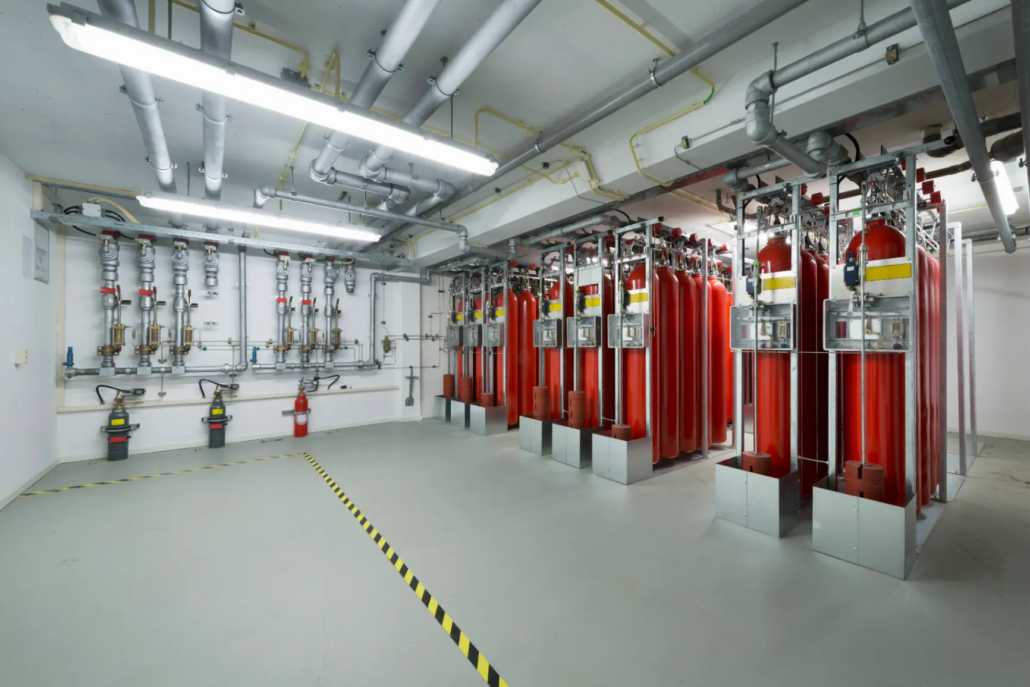
A complete clean agent system includes agent storage cylinders, a discharge network of pipes and nozzles, a detection system, a control panel, and audible and visual alarms. Because lives and valuable assets depend on it, regular inspection, testing, and maintenance of these systems is essential and is mandated by fire codes and NFPA standards.
Choosing a clean agent fire suppression system should always involve a professional fire protection assessment of the space, its hazards, occupancy, and the sensitivity of its contents. The right advanced fire suppression design balances agent type, room integrity, and budget.
In the event of a fire, clean agents provide the speed of gaseous fire suppression with the reassurance that protected equipment survives intact. For any facility where fire safety and asset preservation matter equally, a clean agent system is a modern, dependable, and forward-looking investment.
Could a Clean Agent System Be Right for Your Facility?
The right fire suppression solution depends on your facility, equipment, and fire protection needs. Contact VFS Fire & Security Services for expert guidance on clean agent fire suppression systems.


