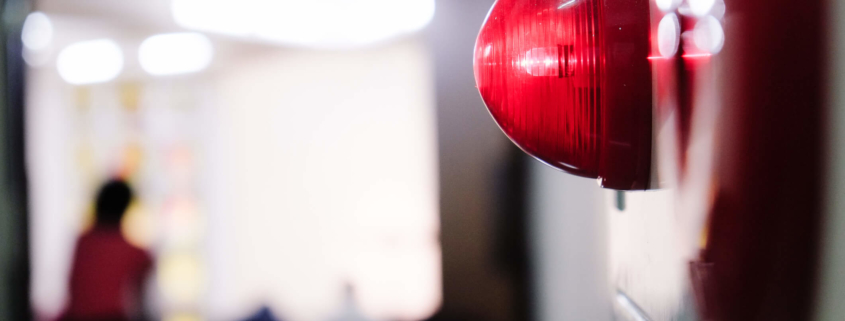
Fire Alarm in Building

The U.S. Fire Administration estimates that fires in commercial buildings cost owners over $2.4 billion per year. Wowza! This considered, monitored fire alarm systems are essential in the prevention of fires in commercial buildings.

Moreover, fire alarm systems can help to:

  • Reduce damage to property
  • Protect valuable assets
  • And, save lives

But today, we have to ask: Is a regular fire alarm system enough?

OK, OK… Before you roll your eyes, hear us out. Fire alarm systems are an excellent and crucial first step in protecting your property. However, as a property owner, you may be able to do more!

A monitored fire alarm system can help to further prevent or reduce costly damage to your property while also better protecting its residents.

Read on to learn what a monitored fire alarm system is and how it can better protect your property.

What is a Monitored Fire Alarm System?

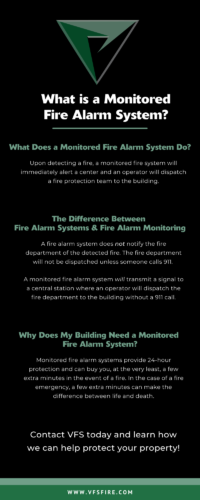
A monitored fire alarm system is an alarm system that has been programmed to transmit signals to a central station or fire control center. In simple terms, when the alarm goes off, the system will immediately alert an operator who will dispatch the appropriate fire protection team to your building.

A monitored fire alarm system ensures that the fire department is alerted to the fire as quickly as possible, without someone having to make the call. The seconds or minutes that a monitored fire alarm system might save you could make the difference between life and death (as dramatic as it sounds, it’s true!)

Monitored fire alarm systems are most commonly used in commercial facilities—and for good reason.

What is the Difference Between a Fire Alarm System and Fire Alarm Monitoring?

A fire alarm system sets off an alarm—usually a series of local, audible devices—to alert people in the building that a fire has been detected and to evacuate immediately. A fire alarm system does not notify the fire department of the detected fire. The fire department will not be dispatched unless someone calls 911.

On the other hand, a monitored fire alarm system will transmit a signal to a central station or fire control center where an operator will dispatch the appropriate fire department to your building—without anyone in the building calling 911.

How Does a Monitored Fire Alarm System Work?

A monitored fire alarm system has an installed control panel that will detect a fire and immediately transmit a signal to a monitoring station. The operator at the station will notify the fire department when they receive the signal. 


Signals can be transmitted via:
  • Cell phones
  • Phone lines
  • Radios
  • The internet

Why Does My Building Need a Monitored Fire Alarm System?

The answer to this is simple: Monitored fire alarms buy you, at the very least, a few extra minutes. In the case of a fire, a few extra minutes can be the difference in both saving buildings and saving lives.

In as little as thirty seconds, a fire can double in size, according to the U.S. Fire Administration. Additionally, a fire will spread even quicker if its surroundings are flammable, such as products that may be found in a warehouse or particular furniture.

If your building is equipped with a fire alarm system that isn’t monitored, the fire department will only be dispatched when someone manages to call 911 after sounding alarms, a fire suppression system or sprinklers, and a quick evacuation of all residents.

Considering these stressful protocols, how quickly do you trust your residents to call 911?

When Will the Monitored Fire Alarm System Protect My Building?

Monitored fire alarm systems provide 24-hour protection, seven days a week. 

For instance, even if a fire occurs at nighttime or while your building is unoccupied, a monitored alarm system will ensure there is no delay in notifying the fire department.

How Do I Know If My Fire Alarm is Monitored?

A common error amongst commercial building owners is incorrectly assuming their fire alarm systems are monitored. Consequently, when a fire occurs, the call to 911 is severely delayed. This error leads to the destruction of the buildings that might have been saved if the proper precautions had taken place.

At VFS Fire & Security Services, we urge you not to wait until a catastrophic loss to have your system inspected.

The default option for many fire alarm systems is the installation of a single-station fire alarm, which doesn’t include the feature of sending a signal to the fire department.

If you’re not sure if your fire alarm system is monitored, you can have a fire and security service quickly inspect your system to let you know. At VFS, our system upgrades team can review your existing plans and make scalable proposals to meet your building, code, safety needs, and budget. 

Not sure if your building is due for an inspection? Read our complete guide to fire and safety inspections for your facilities.

The Bottom Line

Fires happen often—every 63 seconds, in fact. This considered, commercial property owners should be adequately prepared to avoid the costly damages to their valuable assets and protect their residents.

Monitored fire alarm systems are a strong method of improving the protection of your property and its residents by ensuring the fire department is dispatched as quickly and efficiently as possible.

Don’t wait until it’s too late. Start a conversation with us today and let’s figure out how to best protect your building.
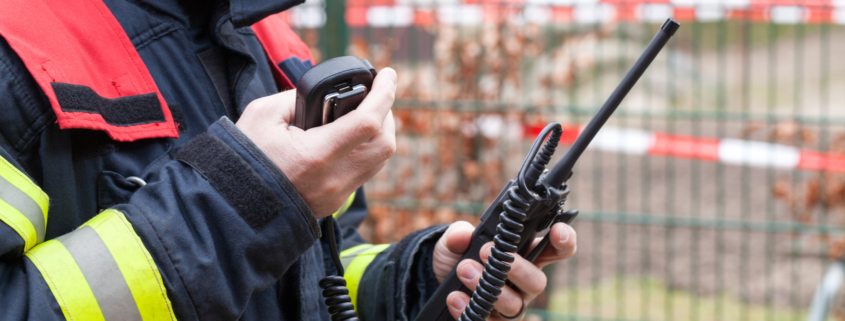
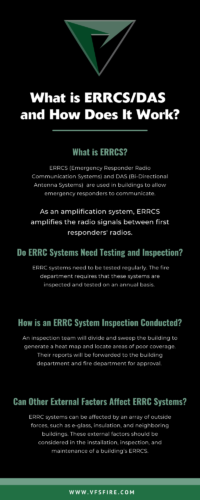
What is ERRCS/DAS and how does it work?

ERRCS don’t have to irk you! VFS Fire & Security Service’s Director of Fire Alarm Operations, Kevin Gregory, joins us to explain the importance of updating your alarm and communication systems.


What Are ERRCS and DAS? 

ERRCS stands for Emergency Responder Radio Communication Systems, also known as Bi-Directional Antenna Systems, or DAS. 

The ERRCS and DAS are very similar; both systems are used within commercial and residential buildings to allow emergency responders to communicate with each other via two-way radio in areas that they may not have been able to in the past.

As an amplification system, ERRCS amplifies the radio signals between first responders’ radios during an emergency. 

Why Did ERRCS Systems Become So Important?

During the September 11th attacks in New York City, emergency responders experienced difficulty communicating with each other in rescue and recovery efforts. These difficulties included full radio communication failures, which made the first responders inside buildings lose contact with dispatch and fire crews outside, risking the lives of the first responders and hindering their rescue efforts.

The communication failures on 9/11 spiked awareness for high-functioning ERRCS/DAS, highlighting the need for tools that would allow responders to communicate without interruption or signal loss in the event of an emergency. Since 9/11, ERRCS and DAS have become a critical priority for commercial building owners. 

What Are the Requirements of an ERRCS System?

While the requirements for ERRCS used to apply only to buildings within the specific guidelines–any building over three stories or with underground parking–requirements can now apply to most new buildings or projects.

The building department and/or fire department can enter a new building project, regardless of its size, and review the ERRCS. In this review, the building department may test for signal strength and require that an additional amplifier be installed. 

How Many Systems Are Required in Commercial Buildings?

Typically, buildings require one system. However, several factors can affect the number of systems required in a space, such as the building’s size and layout. These factors may suggest additional amplifiers or other components need to be installed. For more information, learn the five things CRE owners should know about installing ERRCS, here.

To determine the number of antennas required in your building, an inspection team may utilize heat maps and sweep tests. 

What is a Heat Map?

A heat map is generated through a sweep test or a 20 grid test. In a sweep test, an inspection team will divide the building into 20 sections and test each section with a spectrum analyzer and either a fireman’s radio handset or a signal generator. 

The team will then run the results through software to create a report and a heatmap. This report will display the areas of the building which need better coverage as well as the locations in which the signal is strong. 

Do ERRCS Need Testing and Inspection?

ERRC systems need to be tested regularly. The fire department requires that these systems are inspected and tested on an annual basis. 

How is an ERRCS Inspection Conducted?

An inspection team will conduct an inspection process similar to the 20 grid test in which they will divide and sweep the building to locate areas of poor coverage. Their reports will be forwarded to the building department and fire department for approval. 

Inspections are Essential in Maintaining ERRCS/DAS

Inspections and maintenance are critical to the safety of your building. At VFS Fire and Security Services, we specialize in installing and inspecting ERRCS. There’s an ongoing need and requirement for testing and inspection on an annual basis to ensure that the integrity of the system is still operational with NFPA updates and requirements

What are LEED Buildings and How Do They Affect ERRCS?

LEED (Leadership in Energy and Environmental Design) is a third-party green building certification program that focuses on efficiency in designs. For instance, LEED buildings can have innovative windows made from low-E glass which stops outside weather conditions from affecting the interior temperature of the building and more efficient insulation.

However, low-E glass can cause low signal attenuation that impacts ERRCS. Most commonly, E-glass alters the requirements for your ERRCS in regard to needing additional amplification systems throughout the building. 

Can Other External Factors Affect ERRCS?

ERRC systems can be affected by an array of outside forces. For instance, the signal can be impacted by the construction of neighboring buildings as well as construction supplies and choices. These external factors should be considered in the installation, inspection, and maintenance of a building’s ERRCS. 

Read more about your inspection and maintenance schedule in our blog It’s time to get it together and inspect your building more than once a year!

Why do fire inspection reports take so long?

Don’t tell anyone, but we know that a fire inspection report takes a long time. 

In an effort to explain why we’re going to lead you in a ‘behind the scenes look at the internal processes and why these reports take what seems like forever. 

When systems or devices need maintenance we often can send a repair technician to you within 24 hours (or sooner in emergencies!) Our goal is to be proactive and ensure that our systems keep you safe from harm.

What’s Included in a Fire Inspection Report? 

Clear Sightlines

One of the main elements of your fire inspection report is ensuring there are clear paths for firefighters to reach the building and for patrons to exit the building. If an emergency does happen at your commercial property, there needs to be easy access in and out of the building. This part of the inspection report will likely also include making sure your building remains up to date with fire codes. 

If there are main identifiers around the building that firefighters should be aware of (think trees or other identifying information), that also needs to be included in the fire inspection report. 

Certified Fire Extinguishers

Included in this inspection is counting the number and type of fire extinguishers throughout the building.  VFS Fire and Security services specialize in portable fire extinguishers. Per NFPA code fire extinguishers are required to be inspected and certified by a licensed fire protection contractor. There are a LOT of different types of fire extinguishers including:

  • Water Mist
  • Clean Agent
  • Foam
  • Wet Chemical
  • CO2
  • ABC Dry Chemical
  • Class A, B, C, D, and K

Inspecting all of these extinguishers takes time, which further delays that report hitting your desk. 

Emergency Lighting

Emergency illumination could mean life or death in an intense situation. Ensuring your emergency lighting is working and in the correct areas is essential to the fire prevention and safety of your building. 

We can help! 

There are so many other moving parts that are included in a fire safety inspection. The expert team at VFS Fire and Security Services has a breadth of knowledge to provide all regularly scheduled and code-mandated fire protection system inspections. The frequencies of these inspections ensure the most effective operating conditions for your building all year round and are critical to keeping current with industry and insurance codes. 

We have a diverse team of experienced fire protection professionals capable of inspecting and servicing even the most complex fire protection systems. Our advanced platforms and highly trained dispatch team allow us to manage inspections and testing from inception to execution. 

We tell you what’s due, when it’s due and why it’s due, and are constantly communicating to your team to keep you up-to-date on the latest information within your facilities. 

How frequently do you need fire inspections? Learn more about your inspection schedule in this blog post. 

VFS Cookbook

It’s almost Thanksgiving! 

Get your ovens (or deep fryer- but please be careful!) warmed up before Thursday. It’s one of the most wonderful times of the year. Families come together and sit around a table full of delicious food to reflect on what they’re thankful for. And what brings people together better than food? 

Delicious dishes have the ability to bring back memories, to take you back in time to some of your favorite moments. In an effort to get in the spirit of Thanksgiving, our team put together a few of their favorite family recipes that they make with their families.

Read on for the recipes and ideas, and let us know if you try them!

Blueberry Pomegranate Mule 

Blueberry Mule

Starting off with one of the most important food groups on Thanksgiving- booze! Hear from our CEO, Randy Nelson, on his favorite cocktail recipe below:

What are some ingredients & tips on making this meal? 

The ingredients are: 2oz Vodka, 1oz blueberry liqueur, 1oz pomegranate juice, 1oz lime juice, and 2oz ginger beer. 

Combine all ingredients, except ginger beer, in a cocktail shaker. Add ice and shake until chilled. Strain into a Collins glass over ice. Top with ginger beer. Garnish with a mint sprig

What does this dish mean to you? 

This is a great holiday drink to share with family and friends. 

– Randy Nelson, VFS Fire & Security Services President

Pasta Siciliano

While this may seem un-traditional for Thanksgiving, who doesn’t like to spice it up a bit. Italy here we come!

Pasta Thanksgiving dish

What are some ingredients & tips on making this meal? 

Ingredients 

1 (16 ounce) package uncooked farfalle pasta 

 ¼ cup olive oil 

3 cloves chopped garlic

1 teaspoon crushed red pepper flakes

2 tablespoons lemon juice

½ cup pine nuts

1 (2.25 ounce) can sliced kalamata olives

½ cup chopped sun-dried tomatoes

1 cup crumbled feta cheese

Salt and pepper to taste

Directions

Step 1:

Bring a large pot of lightly salted water to a boil. Place farfalle pasta in the pot, cook for 8 to 10 minutes, and then drain the pasta. 

Step 2:

Heat the oil in a large skillet over medium heat, and cook the garlic until lightly browned. Mix in red pepper and lemon juice. Stir in the pine nuts, olives, and sun-dried tomatoes. Toss in the cooked pasta and feta cheese. Season with salt and pepper

What does this dish mean to you? 

It’s a simple meal anyone can make, and who doesn’t love pasta? 

Bacon Loaded Mashed Potatoes

Bacon loaded mashed potatoes

This one is bound to get your mouth watering!

What are some ingredients & tips on making this meal? 

You need potatoes, bacon, mascarpone or cream cheese, and fresh parmesan.  You can prepare the night before and bake before dinner.

What does this dish mean to you? 

Since I made this the first time for my family, they ask for it every year so I’m happy to oblige and make them happy! 

Candied Yams

Candied yams

Something a little sweet to balance out all the savory flavors on your plate.

What are some ingredients & tips on making this meal? 

The main ingredients are brown sugar and maple syrup. And yams of course. Yum! 

What does this dish mean to you? 

Sweet goodness! 

Vanilla Bean Sage Blackberry Galette

blackberry pastry

Delicious freshly baked vegan almond berry galette on wooden rustic background, from above. Sweet food, summer dessert.

Sprinkle a little love and happiness into your holiday dish!

What are some ingredients & tips on making this meal? 

Ingredients include: Love, happiness, vanilla beans, blackberries, and sage. 

What does this dish mean to you? 

The dish reminds me of amazing memories from a long time ago.

– Elizabeth Ziebell, Director of HR

Honey Ham, Turkey, and Stuffing

Thanksgiving stuffing

A special take on the traditional dishes. Butter makes everything better, right?

What are some ingredients & tips on making this meal? 

It needs to be cooked with plenty of spices and butter. 

What does this dish mean to you? 

A time of giving and fellowship. 

Broccoli and Rice Casserole

rice thanksgiving dish

While broccoli isn’t always the first on people’s favorite food list, we’re excited to try this delicious take on it.

What are some ingredients & tips on making this meal? 

Ingredients: 

1 Cup Margarine or butter

1 Cup Chopped Onion

1 Cup Chopped Celery

 2 Cans Cream of Mushroom Soup

 1 Large Jar of Cheese Whiz

 2- 10 or 12 ounces of frozen chopped broccoli (thawed)

1 Cup Minute Rice

Bread Crumbs

Directions: 

Preheat the oven to 375 degrees.  In a large pan saute’ onion and celery in margarine or butter. Add soups, cheese whiz, thawed broccoli and rice. Stir all the ingredients together.

Pour in a 9 x 13 baking dish and top with bread crumbs.  You can make your bread crumbs from day old bread or buy bread crumbs. 

Bake for 45 minutes.

What does this dish mean to you? 

My family always requests I bring this dish to the Thanksgiving meal. 

– Brenda Harrelson

Spinach Salad

spinach salad

It’s always good to have some greens added into the mix, but of course, add some bacon to make it better.

What are some ingredients & tips on making this meal?

Ingredients: 

1 pack of bacon (center cut)

Mustard

Salt &  pepper

Splash of apple cider vinegar

Spinach

1 or 2 Shallot cut up

Directions:

Cut bacon into pieces and fry. Remove bacon from grease and place on paper towel. Add the cut-up shallots to the bacon grease for maybe 1 minute (don’t brown it). Add splash of apple cider vinegar, about 3 tablespoons of mustard, salt and pepper to the grease. This is your dressing for the salad.

Place spinach in a bowl with stems removed and pour grease (dressing lol) over it and toss the salad. This should be done right before you sit down to eat otherwise the spinach will wilt if it sits for too long.  

What does this dish mean to you? 

My aunt always made it for Thanksgiving and I enjoy it now.

– Michelle Day 

Turkey Pizza

turkey pizza

Who doesn’t like pizza on Thanksgiving?! It has turkey on it, right?

What are some ingredients & tips on making this meal? 

It’s like pepperoni pizza, but with turkey instead. 

What does this dish mean to you? 

It means I’m having pizza on Thanksgiving! 

Turkey

Thanksgiving Turkey VFS Cookbook

As we said above, butter makes everything better- don’t limit yourself during the holidays!

What are some ingredients & tips on making this meal? 

Use a LOT of butter! 

What does this dish mean to you? 

It reminds me of family. 

As you head into the holiday season, we hope you have a Happy Thanksgiving and are reminded of all of the areas in your life of which you are grateful. We hope you have a wonderful Thanksgiving filled with yummy food and even better company (and don’t light anything on fire while you’re at it!) 

Let us know what your favorite dishes are to try during the holiday season. Connect with us on our social media pages!

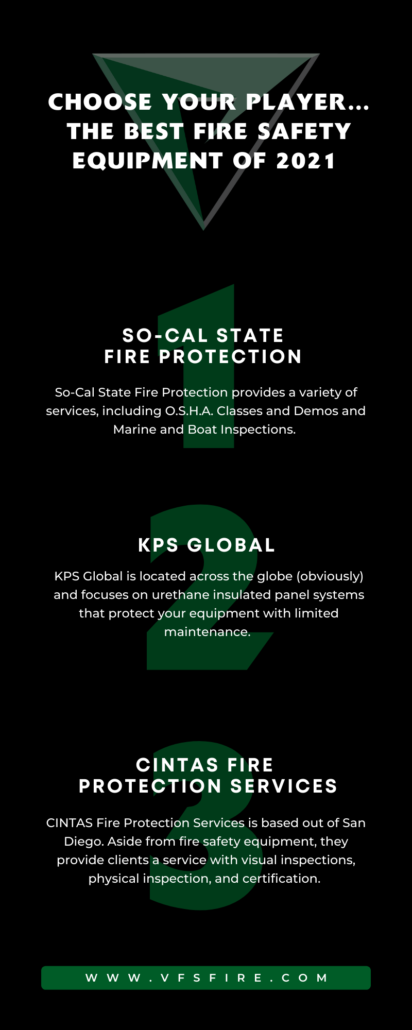
Choose your player… the Best Fire Safety Equipment of 2021

Protecting your commercial building is a huge decision and financial commitment. Here are some of the best options in Southern California for fire prevention. 

Autocall

Autocall believes that people and facilities everywhere deserve to be protected by fire detection systems that deliver unparalleled performance. Backed by a legacy of innovation and invention, Autocall is pushing the industry forward with feature-rich fire detection systems that help to ensure that our customers are safe and their facilities are secure.

AES Corporation

AES Corporation is the leading manufacturer of communication products and services designed for the fire, burglary, and facility applications. Learn how an investment in AES’s wireless mesh telecommunications technology can help you take control of your network, pricing, and future.

Ansul

ANSUL® is a global premium brand of Tyco Fire Protection Products. ANSUL special hazard fire protection products are designed and manufactured to strict standards and tested under the scrutiny of national and international independent testing laboratories and approval agencies.

Kidde Fire Systems

Since 1917, Kidde Fire Systems has been a global leader in fire protection, protecting people, property, and processes from fire hazards. Our fire protection solutions include conventional & intelligent detection and control systems that complement a complete line of fire suppression systems.

Potter

Potter Today, Potter is carrying on the legacy of Charles E. Potter by combining the latest technology in fire protection with the dedicated manpower for which they have been known for over one hundred years. With an unwavering dedication to their customers, Potter looks to continue as the industry standard in both product and service.

Valcom

Valcom’s long tradition of communication leadership and innovation addresses our customers’ most complex communication concerns. Our products are developed based on the customer’s need to relay information rapidly so individuals in various locations throughout an organization receive relevant instructions, and act upon them in emergency situations.

Learn what sprinkler system would work best for commercial buildings here

Best Fire Safety Equipment

How much does a fire alarm system cost?

Well, the short answer is ‘it depends.’

The long answer is that we can help you understand the factors that will influence the cost of a fire alarm system for your commercial property! Let’s get started.

What to Consider

Depending on your property, each of these factors could require different levels and types of fire alarm systems. A good rule of thumb to follow is understanding that the larger and more complex your facility is, the more you will need to invest in your fire protection systems to keep everyone safe in case of an emergency. 

Size of Building

Yes, the cost of a fire alarm system for Knottsberry farms is going to be different than the tiny mom and pop shop on the corner. 

In general, a good rule of thumb to follow is the larger your building, the higher the cost to keep everyone safe in case of an emergency. If the building is older, there will most likely be obstacles for a fire safety crew (like VFS!) to work with.

Additionally, if there are special system preferences and repairs, the cost will reflect this. 

Types of Facilities

The cost of your fire alarm system depends greatly on the environment. Below are some of the more complex environments that may require a little more fire alarm TLC: 

  • Oil Refineries
  • Data Centers
  • Aircraft Hangers
  • Manufacturing & Testing Facilities 
  • Power Generation
  • Healthcare Facilities

What Are You Storing? 

Another big factor in cost depends on what contents you are storing within your facility. More complex environments usually mean high hazard equipment or contents such as: 

  • Chemicals
  • Combustibles
  • Flammable Liquids
  • Corrosives
  • Spray Painting Equipment
  • Welding Equipment

Fire Season 

Fire season is in full swing. As a result, fire safety costs and insurance is going up in price! This can be a factor in how expensive a fire alarm system will cost. This can be another factor in the cost of your fire protection. 

There are different aspects that will contribute to the cost of a fire alarm system like: 

  • Where is it? 
  • What state? 
  • How big is the building?

Depending on these factors, additional monthly fees could apply. 

Looking for more specifics about your commercial or educational building? Reach out to VFS Fire and Security Services today to learn more information. For more on the different fire sprinkler systems available to you, read on here. (Psst! Fire suppression and fire sprinklers are not the same!)

Kitchens: More Than a Place to Steal Your Coworker’s Lunch!

Commercial kitchens should be at the top of the priority list for fire safety management.

Educating your employees on proper fire safety protocols is essential to ensure their workplace safety. In order to keep them safe from harm, they need to know what steps to take in the event of a fire—and no, ‘fricken large ones’ is not correct. In an effort to help guide your fire safety training endeavors, we’ve put together a few tips to improve your employees’ education surrounding building fire safety.

Start With Necessary Information

We think it’s safe to say that most employees do not want to sit through a three-hour-long fire and life safety training. To start, ensure you’re touching on all the ‘need to know’ topics of fire safety.

As you dive deeper into fire safety training, you can go over additional topics that may not be as urgent. Urgent topics to review and discuss should include:

  • Types of fires that occur in the workplace
  • How to extinguish the different types of fires that may occur
  • Major causes of fire accidents in the workplace
  • The exits are available to employees in case of emergency

Make sure your employees know the various hazards in your workplace.

Cooking Equipment

The National Fire Protection Association (NFPA) claims that the main cause of fires in office buildings is cooking equipment. Office and commercial buildings typically have cooking equipment. Whether there is a mass amount of equipment or one small kitchen for employees, there are safety measures that should be taken as a part of fire prevention.

A few of these safety measures include:

Clean Grease Often 

The office kitchen isn’t known for being the cleanest place to cook food, and grease build-up can cause fires to spread quickly.

Ensure Equipment is Maintained Regularly 

Old equipment increases fire risk and puts employees and the building property at risk. There are specific commercial kitchen requirements that may apply to an in-office kitchen. 

The precautions with gas-fired appliances include being installed by professionals, no oil with gasoline, and only specific locations within the building containing gas-fired appliances.

Kitchens are typically protected by et chemical suppression systems. These Extinguishing methods are specific to the type of cooking fires that may occur in a commercial kitchen. When triggered, the system discharges immediately with a liquid that, when sprayed onto the fire, cools the flames almost instantaneously.

When this liquid comes into contact with oils and fats it creates a foam, subsequently cooling the affected area and preventing the spread from reigniting. 

At VFS, your building’s safety is our top priority. With over 25 years of experience, our fire and life safety experts are prepared to ensure your building remains safe from harm. 

The equipment we install, inspect, and maintain is only one component of your fire and life safety initiatives. The other aspect includes employee training! Your employees must be educated on what to do in case of an emergency.

Contact us today to talk about how we might work together!

Suppress Fires, Not Feelings

We get it, you’re working with a tight budget and didn’t consider fire safety as a part of the bottom line. While each commercial building might have different needs and pricing, investing in a clean agent fire suppression system is cheaper than the financial consequences of your building burning down. 

Fire Suppression Systems

Fire suppression systems are used to extinguish or control fires and are activated by heat, smoke, or a combination of the two. Suppression systems are typically found in places like museums, libraries, data centers, and archives. 

Unlike wet-pipe sprinkler systems, suppression systems use gaseous, chemical or foam agents to suppress the fire, rather than water. This aids in the preservation of sensitive equipment and content within a particular environment. There are many different applications of fire suppression depending on the area in which these systems are housed. 

There are different types of fire suppression systems that VFS can install. 

Clean Agent Fire Suppression

Clean agent fire suppression is a term used to describe the use of inert gases to extinguish a fire. These systems all have three main components: 

  • Smoke Detector
  • Control Panel
  • Notification Devices

When the smoke detector is triggered, it sends a signal to the control panel which then alerts the notification devices, activating the release device to suppress the fire.

Clean agent fire suppression systems are fast-acting and most effective in protecting sensitive equipment and environments because they are designed to suppress the fire in its incipient stage. Clean fire agents are electronically nonconducting and unlike water, they won’t ruin electrical components or electronics.

Clean agent fire suppression systems are most often found in server rooms, record/file repositories, and data centers that require an increased level of protection to prevent unnecessary and accidental discharge of systems. 

The Details

  • Inert gases: Nitrogen, argon, and carbon dioxide work together by lowering oxygen content in a room below the level that supports combustion, while still allowing a person to breathe keeping your environment and your personnel safe. 
  • Fluorocarbon-based extinguishers are described as “clean agents” as they do not leave any oily residues, particulates, or water damage and rapidly extinguish fires with a superb weight to effectiveness ratio. These extinguishing agents are also safe to use in occupied spaces and offer unique advantages in speed, performance, and safety. 

Fun stuff, right? 

There is a range of costs and options available when it comes to clean agent fire suppression systems. Contact VFS Fire & Security Services today to learn more! 

What is a Public Safety DAS? NFPA, ERRCS and AHJ (Plot Twist, these letters actually mean something...)

You’re not alone if you see all the abbreviations in fire safety and think, “How the h*ll am I supposed to know what that all means?” 

DAS Explained

The amount of NFPA codes is a large number (like large as in over 300…), so we understand it’s hard to keep track of them all! Actually, are you trying to test your knowledge? Take our NFPA Fire Codes quiz and see how you do! 

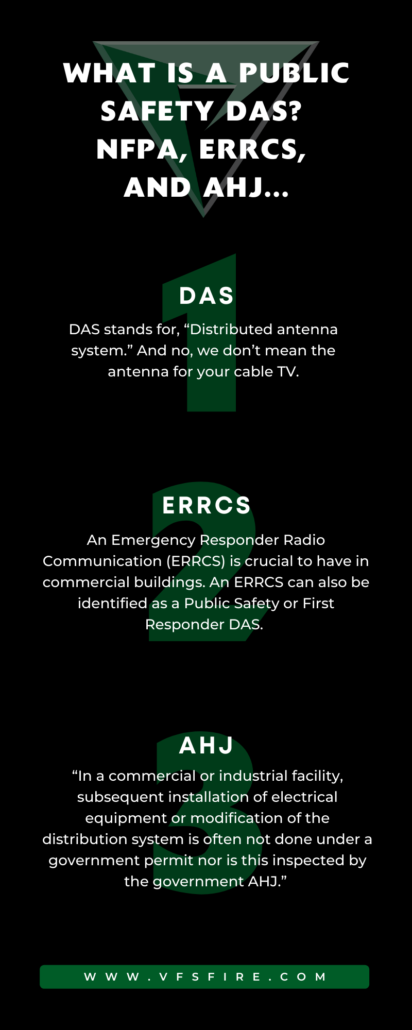
Anyways, DAS stands for, “Distributed antenna system.” And no, we don’t mean the antenna for your cable TV.

The NFPA requires that “Buildings and structures that cannot support the required level of radio coverage shall be equipped with a radiating cable system or a distributed antenna system (DAS) with FCC-certified signal boosters, or both, or with a system that is otherwise approved, in order to achieve the required adequate radio coverage.” 

There are additional factors of the distributed antenna system that any commercial property owner should consider (based on NFPA standards). This might include:

  • Signal Strength
  • Isolation
  • System Radio Frequencies
  • Frequency Changes
  • Critical Areas
  • Radio Coverage

Another main component of NFPA 72 Section 24.5.2 is non-interference. 

In other words, “no amplification system capable of operating on frequencies or causing interference on frequencies assigned to the jurisdiction by the FCC shall be installed without prior coordination and approval of the authority having jurisdiction,” according to the NFPA. “The building manager/owner shall suspend and correct other equipment installations that degrade the performance of the public safety radio system or public safety radio enhancement system.” 

Let’s Talk ERRCS

So surprise, ERRCS is one in the same as DAS. An Emergency Responder Radio Communication (ERRCS) is crucial to have in commercial buildings. An ERRCS can also be identified as a Public Safety or First Responder DAS. 

It turns out all of the fire protection abbreviations can be interchangeable!

How About AHJ?

AHJ, the last acronym to understand for today’s lesson! AHJ stands for, “Authority Having Jurisdiction.” It can be a common misconception that the local fire marshall is responsible for any updates in fire safety. But this is not the case. Oftentimes there are multiple people or authorities who have jurisdiction and are responsible for a facility’s fire safety standards and practices.

The NFPA has regulations set under Code 70E

“In a commercial or industrial facility, subsequent installation of electrical equipment or modification of the distribution system is often not done under a government permit nor is this inspected by the government AHJ.” 

A good question to keep in mind listed from the NFPA is, “Does your management invite a government AHJ to inspect and approve the installation of a new subpanel, the move of a production line, the retrofit for a breakroom, the extension of a circuit, or the addition of a backup generator in your facility?”

Have more questions about these confusing acronyms? Reach out to VFS Fire & Security Services today! 

What is a Public Safety DAS? NFPA, ERRCS and AHJ (Plot Twist, these letters actually mean something...)

What is a Public Safety DAS? NFPA, ERRCS and AHJ (Plot Twist, these letters actually mean something…)