Corrosion can have a serious impact on the effectiveness of your building’s fire protection system, and it can be very expensive to fix.

Learn About The Effects Of Corrosion And What You Can Do To Protect The Safety Of Your Building

Corrosion can have a serious impact on the effectiveness of your building’s fire protection system, and it can be very expensive to fix. This is why identifying and minimizing it are key parts of maintaining a system in a safe and cost-effective manner. Learn more about the dangers of corrosion for fire sprinkler systems and what you can do to prevent it:

Corrosion can seriously affect the integrity of a sprinkler system

Corrosion, or the reaction between a metal alloy and its environment, is an irreversible process which causes “gradual deterioration of metal surface by water, moisture or other corrosive chemicals.” Different fire protection systems are susceptible to different types of corrosion, however, wet sprinkler systems are most commonly used.

One of the costliest effects of corrosion is how it can negatively affect the integrity of sprinkler piping systems. Accumulated corrosion in pipes can cause leaks and limit the flow of water, making sprinkler systems less effective, and sometimes even completely obstructing water to a sprinkler when it’s most needed – during a fire.

Oxygen is the primary cause of serious corrosion in wet sprinkler systems

Trapped air in wet sprinkler systems provides a source of oxygen that can cause corrosion, meaning that reducing air pockets is essential to lower the chance of damage to the piping. There are a variety of methods used to mitigate oxygen corrosion, including the regular usage of an air-release valve or air vents, using nitrogen as a supervisory gas, and limiting the infusion of oxygen-heavy freshwater into the piping system. Employing an air-release valve may also have other benefits, including reduced water delivery time and reduced alarm ring delays.

Microbiological growth is another cause of sprinkler system corrosion

A report (document) by the National Fire Protection Association states that microbiological growth is an increasing concern for fire sprinkler systems. Instead of typical corrosion, which usually develops somewhat evenly over longer periods of time, microbiological growth is more concentrated and accelerated – meaning that it can grow very quickly in a small area of piping to create a large obstruction or a small pinhole in the piping, which can severely impact the efficacy of the entire system. According to the NFPA, there are many examples of systems with feed mains over 60% obstructed from biological growth, and in some cases, thousands of pounds of debris can even accumulate in medium-sized piping.

There is often no indication of a problem until a leak or a fire occurs

One of the most insidious aspects of fire system piping corrosion is that building owners, managers, operators, and sometimes even less-thorough inspectors have no idea that there is any problem until a leak occurs. When a leak or other serious problem happens in the system randomly, the building’s owners and occupants are actually quite lucky – if it occurred during a fire, it could lead to building damage or injury.

Unfortunately, the problem may not be identified until during or after the emergency in cases where corrosion has caused unknown blockage or leakage of a fire sprinkler piping system, unless regular inspections are performed, including internal obstruction inspections that are a part of a 5-year inspection cycle.

This is just another reason why high-quality inspection, proper maintenance, and sometimes replacement of components of a fire protection apparatus are necessary. At LifeSafety Management, we understand that corrosion is just one of many threats facing the integrity and effectiveness of your building’s life safety systems.

Need Help With Inspections and Maintenance?

At VFS, we partner with our clients to ensure their maintenance and inspections are scheduled and performed regularly. The expert team at VFS Fire & Security Services has the breadth of knowledge to provide all regular scheduled and code-mandated fire protection system inspections. We have a diverse team of experienced fire protection professionals capable of inspecting and servicing even the most complex fire protection systems. 

Our advanced platforms and highly trained dispatch team allow us to manage inspections and testing from inception to execution. We tell you what’s due when it’s due, and why it’s due, and we constantly communicate with your team to keep you up-to-date on the latest information within your facilities. Allow us to be your trusted Inspector Gadget and take on all your inspection and maintenance needs.

Do you have your inspection already scheduled? Here’s how to prepare for a fire safety inspection before it occurs.

Electric vehicle charging stations bring fire risk during installation, charging and in their energy storage systems (ESS). These risks will require special solutions.

Did you know that California is banning the sale of new gasoline-powered vehicles starting in 2035? Wow! This is a significant feat for the country’s most populous state and the center of U.S. car culture. Why is California doing this? This ban is a step in the state’s battle against climate change by reducing the amount of carbon discharged into the atmosphere.


However, as with any significant change, this ban will come with both positive and negative effects. One of those effects will be increased fire risk with electric vehicle (EV) charging stations. Let’s discuss.

Electric Vehicles Becoming More Common

EVs are rising in popularity and will likely become a more popular occurrence on the world’s roads. Bloomberg estimates EVs will grow from around 3 million vehicles in 2020 to 66 million by 2040. This means that in 2040, electric vehicles will represent two-thirds of the global auto market.


Why the sudden increase in EV sales? Electric vehicles are becoming less expensive and their batteries are able to withstand longer distances than before. These recent updates combat two of the largest cons of electric cars. 

The Growth in Electronic Vehicle Sales Will Demand More Charging Stations

With the rise in EV sales, we can expect to see more charging stations being built across California. Why? While EV owners don’t need to stop to top off their tanks, the success of the EV revolution depends on owners having access to an adequate charging network.


In fact, EV charging is becoming a growing industry; In 2021, EV charging was a $6.8 billion USD market already and is expected to reach over $20 billion USD with a compound annual growth rate (CAGR) of 38% by 2025. Such efforts will be supported by Tesla and other EV companies and likely result in millions of charging stations across the country. 

How Will the Ban of Gasoline Vehicles Affect the Fire Protection Industry?


The ban on gasoline vehicles and the resulting rise in both electric vehicles and charging stations will result in several fire risks. Let’s take a closer look.


Fire Risks With the Installation of Electric Charging Stations

 EV chargers face the same fire risk as any electrical installation. The safety of the charging stations can be affected by wiring components as well as the competency and experience of the installer. Improper or outdated wiring can short circuit, arc, and/or overheat, all of which can result in a serious fire. 


These risks are heightened in home chargers. 

Fire Risks While Electronic Vehicles Are Charging

Malfunctions are bound to occur in the transfer of high-voltage electricity between charging stations and vehicles. These malfunctions can result in a fire. The increase of charging stations entering the market brings an increase in these malfunctions and associated fire risks. 

Additionally, these vehicles use lithium-ion batteries, which are sensitive to high temperatures. When exposed to high temperatures, an uncontrolled self-ignition can occur.

Fire Risks Associated with Energy Storage Systems (ESS)

ESS will be necessary to supplement the direct grid electrical supply and accommodate a large demand for EV charging. The primary risk of these systems is damage or overheating from an internal fault that could cause a fire.

How Can Electric Vehicle Owners Mitigate Fire Risks?

The U.S. Fire Administration recommends the following tips for owners of electric vehicles to follow in order to reduce the risk of fire. 


  • “Follow manufacturer’s guidelines when charging your vehicle. Check with your local dealer if you need additional information.
  • Purchase a charging device that is certified by a nationally recognized testing laboratory.
  • Plug Level 1 EV chargers directly into an outlet designed to handle the amperage of the charging device. Never use a multiplug adapter or extension cord.
  • Install a residual current device with the charging unit. It will turn off the power if a fault is detected and help prevent a fire.
  • Place all charging device components out of reach of children when not in use.
  • Maintain the components of your charging station according to the manufacturer’s maintenance guidelines. Signs of excessive wear may indicate a potential shock hazard. Never use an EV charger with obvious signs of damage.
  • Cover the EV charging station outlet to stop water from entering. Check the manufacturer’s guidelines to make sure it is safe to charge your EV in wet conditions.”

How Can Building Owners Mitigate the Fire Risks Associated with Electric Vehicles?

Fire authorities have acknowledged these risks and have recommended that any building with electric vehicle charging or EV parking should be addressed as a special hazard. 


Read on to learn more about special hazards and special solutions.

Interested in Learning More?

If your business functions in an environment exposed to fire risk from electric vehicles, ensuring that you have solutions to protect against special hazards is imperative.

For more information, check out our fire protection solutions.

Fire protection sprinkler system with red pipes is placed to hanging from the ceiling

Frequent fire protection system inspections and maintenance are essential in protecting your property and, more importantly, your people. But, building owners may have questions such as: who can inspect my fire protection systems? Do they need a license? How often should the systems be inspected? What will be covered in the inspection?

First, What is a Fire Safety Inspection?

A fire safety inspection is a necessary examination of a building or structure and its relevant fire safety documents. A fire safety inspection measures how well your building is managed in regard to fire safety. 

Legally, buildings must comply with a set of building codes and ordinances to keep their occupants safe. A fire safety inspection ensures you are doing so and calculates the potential risk factor in a given facility. 

Who Can Inspect and Maintain My Fire Protection Systems? 

This is a tricky question that does not, unfortunately, have one answer. Why? NFPA standards aren’t clear on who, exactly, may work with a fire protection system across the United States. NFPA 25 requires that those engaging in inspection, testing, and maintenance must be “qualified.”  The meaning of “qualified” may be left up to individual jurisdictions.


However, if you own a building in California, there are some clear rules to follow. Let’s take a look.


In California, a license is required to test or maintain a fire sprinkler system.

From the California Health and Safety Code:

“13196.5. (a) Except as provided in subdivisions (b), (c), and (d), no person shall engage in the business of servicing or testing automatic fire extinguishing systems without a license issued by the State Fire Marshal pursuant to this chapter.”

We understand that maintaining fire sprinkler systems can be complicated. If you have questions, we have answers. Reach out to us today if you are unsure who should inspect your fire protection system. 

Who is Responsible For Ensuring All Systems Are Properly Maintained?

According to NFPA 72, National Fire Alarm and Signaling Code, the owner is responsible for inspections, testing, and maintenance, as well as any alterations or additions to the fire alarm system. 

If your building’s fire system is being regularly inspected and is up to code, it significantly decreases the probability that your property will be destroyed in the event of a fire. 

How Often Should Fire System Inspections Occur?

According to the NFPA code, inspections of your fire and life safety systems are required to occur on a quarterly and annual basis. 

What is NFPA Code?

The National Fire Protection Association (NFPA) has over 300 codes and standards that apply to nearly all buildings, services, installations, and processes. NFPA codes are designed to reduce or minimize the effects of fires and other safety risks. 

A little intimidated to start reading 300 NFPA codes and standards? That’s okay- we get it! Begin by checking out this article, where we break down a couple of codes you should know. 

What Will Be On My Inspection Report?

Your inspection report will include:

  • The location of every device in the building
  • Whether each device passed or failed inspection
  • The reasons why each device passed or failed inspection
  • Date and time stamps of when each device was inspected
  • Device inventory 
  • Device warranty status
  • Indication of the length of time devices have been in service
  • Verification of report results

Do All Fire System Components Need to Be Checked With The Same Frequency?

Some components of a fire system need to be checked more often than others. 

For instance, a fire pump may require weekly or monthly inspections, whereas sprinkler systems may only need a quarterly check. 

Need Help With Inspections and Maintenance?

At VFS, we partner with our clients to ensure their maintenance and inspections are scheduled and performed regularly. The expert team at VFS Fire & Security Services has the breadth of knowledge to provide all regular scheduled and code-mandated fire protection system inspections. We have a diverse team of experienced fire protection professionals capable of inspecting and servicing even the most complex fire protection systems. 

Our advanced platforms and highly trained dispatch team allow us to manage inspections and testing from inception to execution. We tell you what’s due when it’s due, and why it’s due, and we constantly communicate with your team to keep you up-to-date on the latest information within your facilities. Allow us to be your trusted Inspector Gadget and take on all your inspection and maintenance needs.

Do you have your inspection already scheduled? Here’s how to prepare for a fire safety inspection before it occurs.

Firefighter teaching about fire extinguisher to school kids in classroom during fire prevention week

Since 1922, the National Fire Protection Association has sponsored the public observance of Fire Prevention Week. Throughout the past century, fire prevention week consisted of children and adults learning how to stay safe in case of a fire. Additionally, firefighters provide lifesaving public education in an effort to drastically decrease casualties caused by fires.

In this article, we’ll review the history of fire prevention week and reveal the 2022 campaign. Let’s dive in.

The History of Fire Prevention Week

In 1925, President Calvin Coolidge proclaimed Fire Prevention Week a national observance. This makes Fire Prevention Week the longest-running public health observance in the United States. 

Why FPW is the Week of October 9th

Fire Prevention Week is observed each year during the week of October 9th in commemoration of the Great Chicago Fire. According to History.com, the Great Chicago Fire “burned from October 8 to October 10, 1871, and destroyed thousands of buildings, killed an estimated 300 people and caused an estimated $200 million in damages.”

Fire prevention week occurs during the same week each year to honor the lives lost in the Great Chicago Fire and make efforts to prevent similar events from happening in the future. 

The 2022 “Fire Won’t Wait. Plan Your Escape” Campaign 

 The campaign of the 2022 Fire Prevention Week™ (FPW) is “Fire won’t wait. Plan your escape”™.  The campaign for 2022 strives to educate participants about simple but important actions they can take to keep themselves and others safe from home fires. Key focuses of this campaign include fire escape planning and practicing as well as alarms.

Why Fire Escape Plans Are so Important

According to NFPA, today’s homes burn faster than ever. In the event of a fire, you have about two minutes or less to safely escape from the time the alarm arounds. One’s ability to get out of the home during a fire depends on early warning from smoke alarms and advanced planning.

How to Start Creating a Fire Escape Plan

Every home is different and therefore, every fire escape plan will be different. Consider starting with these guidelines:

  • Draw your building floor plan using a grid.
  • Label all the rooms and identify the doors and windows.  
  • Plan two escape routes from every room.
  • Provide alternatives for anyone with a disability.
  • Agree on a meeting place where everyone will gather after you have escaped

Fire escape plans should consider everyone in the home or building. For example, children, older adults or people with disabilities may need additional assistance. Consider assigning someone to help them in the event of an emergency. 

While NFPA is focusing on home fires, these same concepts carry into commercial fires as well. An updated fire protection system and a practiced escape plan can save the lives of people in commercial buildings. Those working or owning commercial buildings can practice fire safety by ensuring their fire escape plan is well-known and practiced. 

Let’s Talk Fire and Smoke Alarms

Smoke alarms sense smoke well before people can and should effectively alert people of danger. As a general rule, alarms should be:

  • In every bedroom
  • Outside of the sleeping areas (such as a hallway, for example)
  • On each level, including the basement 

Smoke alarms should not be installed over the stove or in bathroom shower areas. The heat from these areas may trigger the alarm. 

The requirements for commercial buildings differ from standards for homes. We urge owners of commercial buildings to research the requirements for their property. Find more information on NFPA 72, here.

For more information about NFPA’s Fire Protection Week, check out their website!

At VFS, our mission is to grow our business by serving our community and protecting that which matters most to our clients; life and valued assets.  As the provider of choice within our markets, we provide complete fire protection and integrated life safety solutions, focused exclusively on exceeding our customer’s expectations every time.

Learn more about who we are and why we do what we do, here.

Engineer checking Industrial fire control system,Fire Alarm controller, Fire notifier, Anti fire.System ready In the event of a fire.

An unscheduled fire safety inspection can feel like a pop quiz for property owners. However, just like in school, this pop quiz won’t be too bad… if you did your homework!

(Don’t worry, you won’t need to do any pre-calc to prepare for a scheduled or unscheduled fire safety inspection!) All you need to do is follow a few simple steps.

Below, we’ve prepared a fire safety checklist to help you prepare and pass your next inspection—whether it’s scheduled or a drop-in—with flying colors.

Let’s take a look!

Prep Your Paperwork

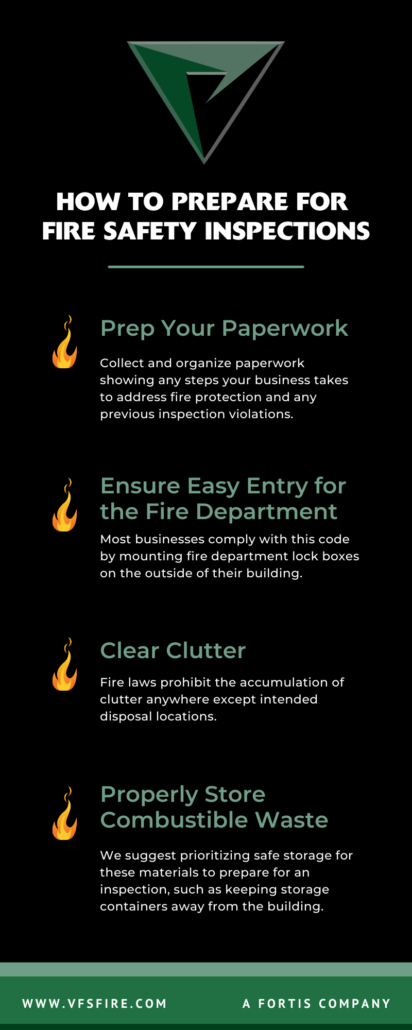
Collect and organize paperwork showing any steps your business takes to address fire protection and any previous inspection violations. This demonstrates that your business is committed to meeting requirements.

Collect Proof of Services and Inspections

Keep track of services and inspections that licensed professionals have performed on your systems, such as:

  • Serviced fire alarms
  • Fire extinguishers
  • Sprinkler systems, and
  • Fire pumps

Make Appointments for Outstanding Maintenance

It’s time to sit down and make some appointments—yay! Contact some trained professionals (like our team at VFS) to help with the maintenance of your fire protection systems. This will not only help you pass inspections but also will protect your people and property.

Not sure if your commercial property needs servicing? Read on to learn how often fire protection systems should be serviced.

Take Precautions Against Special Hazards

Special hazards are areas that require special hazard fire equipment and fire alarms.

Building owners should note that special hazards are not specific fire hazards that occur as a result of certain situations or triggers, such as a flammable liquid being too close to a heat source.

Instead, special hazards can be things like gasoline pumps, computer server rooms, or storage areas that may contain flammable or combustible chemicals.

Read on to learn more about solutions to special hazards.

Clear Clutter

To prepare for a fire safety inspection, building owners should make it a priority to avoid clutter. Why? Clutter can quickly become combustible waste and serve as fuel for fires.

Combustible waste can take many forms, including:

  • Trash (i.e. cardboard boxes, paper, cartons, etc.)
  • Debris
  • Plant matter
  • Yard trimmings
  • Fallen trees
  • Wood, and
  • Leaves

Fire laws prohibit the accumulation of these items anywhere except intended disposal locations.

Lastly, property owners should make an active effort to keep their hallways free from obstructions.

Properly Store Combustible Waste

It can be difficult to keep combustible materials off your property at all times. Instead, we suggest prioritizing safe storage for these materials to prepare for an inspection. 

For example, property owners can:

  • Use lids on containers 40 gallons or greater
  • Keep containers exceeding a capacity of 40.5 cubic feet outdoors and over five feet away from construction work
  • Keep storage containers away from the building, and
  • Ensure storage containers near facilities don’t contain oily rags or other unsafe materials without proper container identifications

This will help keep any staff working on the property safe as well as help prepare the space for inspection.

Ensure Efficient Entry for the Fire Department 

According to national codes, all buildings must offer firefighters safe and immediate access.

Complying with this code should be simple. Most businesses comply with this code by mounting fire department lock boxes on the outside of their building.

This way, in the event of an emergency, the fire department can open the lock boxes with a master key and enter the building.

Part of the reason for keeping clutter out is to allow firefighters to safely navigate the building. Trust us, you don’t want firefighters tripping over the cardboard boxes from Amazon during a fire!

Make Sure the Fire Department Has Access to Water

Building owners should clearly mark all fire hydrants and ensure they are available for use. Additionally, fire hydrants must have three feet of clear space on all sides to allow firefighters access. This means that the building occupants should not be parking within this space—sorry Brandon from HR, it’s time to learn to parallel park!

Further, to prepare for inspection, building owners can check the fire department connection (FDC) that allows firefighters to supply water to a sprinkler system. This system should also be marked and accessible.

Need Help Preparing For Inspection?

At VFS Fire & Security Services, we have a diverse team of experienced fire protection professionals who are capable of inspecting and servicing even the most complex fire protection systems.

We tell you what’s due, when it’s due, and why it’s due, and are constantly communicating with your team to keep you up-to-date on the latest information within your facilities.

Read on to learn more about our testing and inspection services.


How to Prepare For Fire Safety Inspections infographic

pipe in a fire sprinkler system

Did you know more fires occur during winter than in any other season? Additionally, cold weather can cause damage to fire sprinkler systems through freezing pipes.

So, what does this spike in fires and damage to fire protection mean for business owners? They must be more vigilant than ever during the winter season to properly protect their property and occupants.

The good news: You don’t have to have powers like Jon Snow to protect your fire sprinkler system from damage!

While building owners can take preventative measures, the most effective method to protect fire sprinkler systems during the winter is to keep up with regular maintenance and inspections – no battling White Walkers necessary! Let’s dive in.

Why Are Fire Sprinkler Systems at Risk During the Winter?

In the winter months, temperatures drop, which can cause water or condensation in pipes to freeze. This can result in the following effects:

  • A frozen pipe can burst and lead to water damage, and/or
  • Pipes with frozen water will not be effective in preventing a fire from spreading

Let’s discuss how building owners can prevent these risks from occurring in their wet and dry pipe fire sprinkler systems.

How to Protect Wet Fire Sprinkler Systems in the Winter

As the name suggests, wet pipe sprinkler systems hold water in their pipes. These systems are most common in structures such as offices and commercial buildings.

These buildings are often temperature controlled during the winter, meaning that the pipes are not likely to freeze.

However, simple issues – such as a problem with the building’s heating system or part of the pipe being exposed to low temperatures – can lead to the pipes freezing and significantly damaging the system.

Maintain Warm Temperatures

According to the National Fire Protection Association (NFPA) standard 25, wet sprinkler systems must be maintained at a minimum of 40 degrees Fahrenheit. This situation may occur when:

  • Insulation is disrupted
  • Pipes exit and reenter the building, or
  • If there’s a lack of building heat

These occurrences may be more common in warehouses, for example.

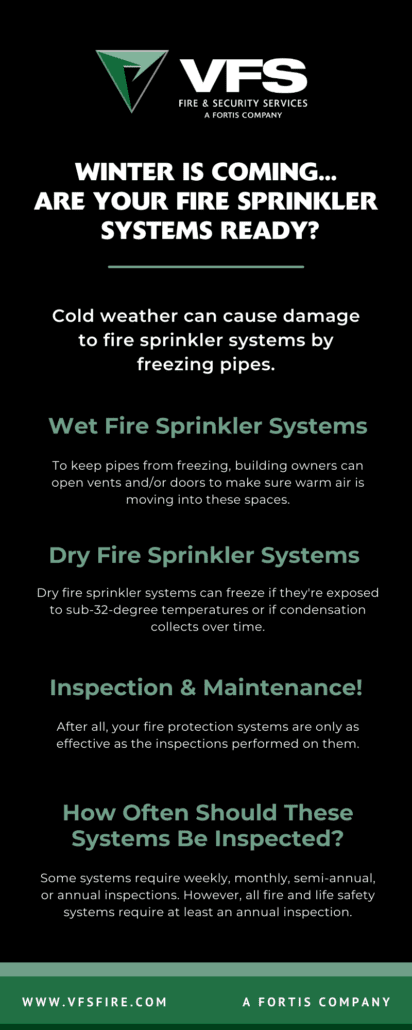
Wet sprinkler systems may be common in buildings with unheated maintenance closets or equipment rooms. Building owners can open vents or doors to make sure that warm air is moving into these spaces to keep pipes from freezing.

How to Protect Dry Fire Sprinkler Systems in the Winter

Dry sprinkler systems keep pressurized air inside their pipes rather than water. Because of this, these systems can withstand freezing temperatures. However, this does not guarantee these systems will not be damaged.

Dry fire sprinkler systems can freeze if they are exposed to sub-32-degree temperatures. Moreover, condensation can collect over time and damage the pipes, especially during winter.

Dry sprinkler systems may be at risk in areas such as: 

  • Fire sprinkler control rooms
  • Parking garages
  • Outdoor event spaces
  • Isolated rooms
  • Unoccupied rooms, and
  • Mechanical rooms

Inspect Drains and Low Points

Building owners can check drains and low points where condensation collects. Building owners can drain these points to keep the condensation from freezing and damaging their dry pipe sprinkler systems.

Inspect Pipe Angles

The angle of pipes is important to ensuring the condensation is reaching the low point drains. Building owners should enlist the help of an experienced technician to complete this step.

The Most Important Step… Inspection and Maintenance!

While building owners can complete the above steps to check in on their systems, the most effective method of preventing fire sprinkler systems from freezing during winter is to keep up with inspections and maintenance.

After all, your fire protection systems are only as effective as the inspections performed on them.

How Often Should These Systems Be Inspected?

How often you service or inspect your fire protection services depends on the device. Some systems require weekly, monthly, semi-annual, or annual inspections. However, all fire and life safety systems require at least an annual inspection.

Worried Your System is Being Damaged by Low Temperatures?

When systems or devices need maintenance, our team at VFS Fire & Security Services can typically send a repair technician to you within 24 hours—sooner in emergencies!

Not sure if you need servicing? Read on to learn more about how often fire protection systems should be serviced.

Does Your System Need an Inspection?

VFS Fire & Security Services wants to help with your winter maintenance. Fortify your building with reliable fire protection systems inspected and maintained by the experts at VFS!

Read on for more information about our testing and inspection services.

infographic about maintaining fire protection systems

employees walking in a healthcare building with sound and communication systems

Hospitals and other healthcare facilities face a unique set of challenges in an emergency, such as mobility issues with patients, additional obstacles with emergency evacuation, and a large staff to inform of safety protocols.

This is why sound and communication systems in healthcare buildings are essential in protecting property and residents in the event of an emergency.

Sound and communication systems serve to protect property and residents as well as combat these challenges in the event of an emergency.

Let’s discuss a few sound and communication systems, how they work, and how they can be used for the safety of residents in healthcare facilities.

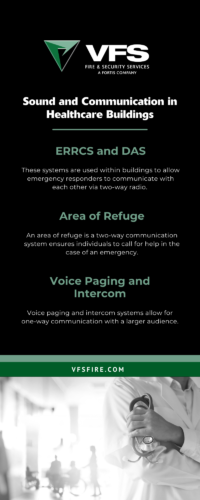
ERRCS and DAS

ERRCS stands for Emergency Responder Radio Communication Systems, also known as Bi-Directional Antenna Systems, or DAS.

ERRCS and DAS are similar; both systems are used within commercial and residential buildings to allow emergency responders to communicate with each other via two-way radio.

Why Are ERRCS and DAS Important?

During the September 11th attacks in New York City, emergency responders struggled to communicate with each other in rescue and recovery efforts. 

These difficulties, such as full radio communication failures, made the first responders inside buildings lose contact with dispatch and fire crews outside. Ultimately, these communication issues risked the lives of the first responders and hindered their rescue efforts.

The communication failures on 9/11 raised awareness of the need for tools that would allow responders to communicate during an emergency. Since 9/11, these systems have become a critical priority for commercial building owners.

How Do ERRCS and DAS Work?

ERRCS and DAS are made of distributed antennas that are installed within a building to amplify particular radio and/or cellular signals ensuring the highest functioning communication for first responders.

These antennas receive external public safety radio signals and retransmit them within the building to ensure penetration in all areas of the building including stairwells, elevators, basements, and other heavily shielded areas.

As an amplification system, ERRCS amplifies the radio signals between first responders’ radios during an emergency. 

Read on to learn more about ERRCS and DAS and how they are crucial in protecting lives and your building.

Area of Refuge

Like an intercom system, an area of refuge two-way communication system ensures that healthcare buildings have a way for individuals to call for help in the instance of an emergency.

These systems are also used in schools, commercial buildings, and other public venues.

How Do Areas of Refuge Work?

Areas of refuge provide a location for building occupants to assemble by an exit and await assistance. These residents may require assistance for a variety of reasons, such as difficulty using stairs or other disabilities.

With these difficulties in mind, these systems were designed to provide hands-free, two-way communication with intelligible audio and visible signals to indicate communication has occurred. These features will allow patients and staff to more easily communicate and receive the assistance they need in the event of an emergency.

Voice Paging and Intercom

Voice paging and intercom systems allow for one-way communication with a larger audience. These systems allow users to announce information to others. This allows the called party to receive information without having to pick up a handset or radio.

How Do Video Paging and Intercom Systems Work?

The paging employee speaks into the telephone and the message is broadcast through a network of speakers to relay. Messages can also be prerecorded and broadcast at different times, depending on the needs of the facility.

Patient Wandering

These systems are essential to preventing patients from getting lost, injured, or exposing themselves to potentially life-threatening situations.

How Do Wander Management Systems Work?

Wander management systems consist of RFID-enabled technology that keeps track of patients within the set parameters of the system to guarantee their protection within the hospital, nursing home, or senior living home. 

Infant Protection Systems

Infants are some of the most vulnerable patients in a hospital. Ensuring infant security is critical not only to the reputation of your hospital but also to nursing staff and new moms.

How Do Infant Protection Systems Work?

These systems can vary depending on the wants and requirements of the hospital. Typically, hospital staff will put some form of location system on the infants, which will monitor their location throughout the building.

With these tracking systems, staff can monitor the location of the infants during an emergency as well as be notified if the infant is taken out of the secured area of the hospital. These systems allow the staff to better protect infants in the healthcare building.

The Bottom Line

These systems allow various teams to communicate with each other to optimize safety protocols and protect staff, patients, and other residents. Further, sound and communication systems can bring peace of mind to building owners as well as the staff and patients in the healthcare facility.

Read on to learn more about our other sound and communication system options.

infographic describing sound and communication systems

security system on a building

As a business owner, building security is crucial to protecting your property and staff.  According to statistics provided by the FBI, 60% of burglaries occur outside of working hours. Why? Outside of working hours, your staff is typically less equipped to respond quickly and efficiently to the incident. In some cases, the staff may not even notice the incident is occurring.

Additionally, following the COVID-19 pandemic, more business owners are managing their business remotely. Not being at their building in person can cause business owners to feel concerned about the security of their business, but they don’t have to!

With the right protocols and systems in place, business owners can feel confident that their building is secure and safe, whether they are clocking in upstairs or from their living room. 

Let’s dive into how to make this possible.

First, How Can Improved Security Benefit Your Business?

We understand–business owners have a lot on their plate and security may not always be the first priority. However, the right security can provide a host of benefits for your business. For example:

  • Improved customer confidence in shopping on the premises
  • Prevention of issues like  break-ins, vandalism, or robbery
  • Heightened employee safety both during and outside of business hours 

Let’s Talk about Integrated Security Systems

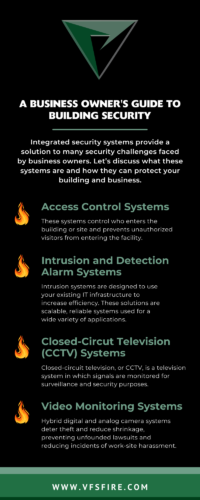
Integrated security systems provide a solution to many security challenges faced by business owners. Let’s discuss what integrated security systems are and how they can protect your building and business (even after business hours or from home!).

Intrusion and Detection Alarm Systems

Intrusion systems are designed to use your existing IT infrastructure to increase efficiency. These solutions are scalable, reliable systems used for a wide variety of applications. They can be utilized in spaces such as mixed-use commercial office complexes to high-risk facilities.  

How do Intrusion and Detection Alarms Work?

State-of-the-art technologies in intrusion systems implement event notifications sent to mobile phones and remote system management. These technologies can keep you up-to-date with the status of your facility, even when you are not there. 

Closed-Circut Television (CCTV)

Closed-circuit television, or CCTV,  is a television system in which signals are monitored for surveillance and security purposes. These signals are not publicly distributed. 

How Does CCTV Work?

CCTV relies on the strategic placement of cameras as well as the consistent monitoring of the footage. CCTV cameras communicate with monitors and/or video recorders through private coaxial cable runs or wireless communication links. This allows the communication to be private and allows only the intended audience to be able to view the footage.

Access Control Systems

As the name implies, access control systems manage access. These systems control who enters the building or site and prevents unauthorized visitors from entering the facility. Access control systems are designed to maintain control over who comes into the building without impeding the work of those who are authorized.

How Do Access Control Systems Work?

While the details can vary depending on the types of access control and system the business owner selects, the main elements of an access control system are typically the same. These elements include: 

  • The tag
  • Tag reader
  • Access control panel
  • Lock(s)

These elements cooperate to create an easy and simple experience for the user. 

Further, these systems can be scaled from small businesses to multi-location companies with thousands of employees.

Video Monitoring Systems

Video monitoring systems provide an array of benefits for a business, such as improving employee safety and productivity.  Hybrid digital and analog camera systems deter theft by preventing unfounded lawsuits and reducing incidents of work-site harassment. 

How Do Video Monitoring Systems Work?

Video Monitoring systems can be analog, digital or hybrid. Business owners can select which of these options works best for their business and their budget.

A digital video surveillance system is “a surveillance system capable of capturing images and videos that can be compressed, stored or sent over communication networks. Digital video surveillance systems can be used for nearly any environment.” Depending on the system, internet protocol (IP) cameras may be used. These cameras require only a local network.

Analog systems use traditional cameras you see in camera systems. These cameras record images to a video recorder and send them through a coaxial cable to a Digital Video Recorder (DVR). Analog systems tend to be simpler than digital surveillance systems. 

Need Help With Building Security For Your Business?

We got you covered.

From high-end access control systems to basic intrusion detection components, our highly skilled VFS Teams design systems that optimize your existing infrastructure and augment them with the latest in proven technologies.

Learn more about our security systems here and start a conversation with us today.

infographic about business owner building safety

a fire hydrant being checked to protect a building during the fall season

Fires can happen anytime but occur more frequently during fall and winter.

Why? Heating equipment, ranging from commercial heating systems to portable space heaters, increases the risk of fire. Additionally, candles, decorations, and cooking contribute to this increased risk.

Don’t worry, you don’t need to put out your favorite pumpkin spice-scented candle or take down those new decorations! We’re here to discuss some fire safety tips to help protect your building during the fall.

Let’s dive in.

What Are the Most Common Causes of Fires?

According to the National Fire Protection Association, the five most common causes of fires in commercial buildings are:

  • Cooking Equipment
  • Heating Equipment
  • Electrical and Lighting Equipment
  • Smoking Materials
  • Arson

How to Reduce These Fire Risks

Commercial property owners can use a few strategies to prevent building fires.

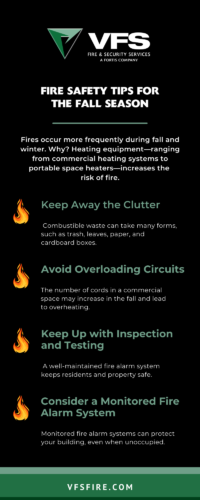
1. Keep Away the Clutter

Clutter can quickly become combustible waste and serve as fuel for fires. Combustible waste can take many forms, such as:

  • Trash, including cardboard boxes, paper, or cartons
  • Debris
  • Plant matter
  • Yard trimmings
  • Fallen trees
  • Wood
  • Leaves

Fire laws prohibit the accumulation of these items anywhere except intended disposal locations. Without proper treatment, such combustible waste can become a significant fire hazard for your building.

Additionally, clutter can block exits and evacuation routes as well as make it more difficult for firefighters to do their job in the event of a fire.

Owners should make an effort to keep the building free from obstructions and keep hallways clear.

Learn How to Store Combustible Waste

We get it—you can’t keep combustible waste off of your property at all times. Instead, you can store this waste safely to improve fire safety.

Property owners should:

  • Keep storage containers away from the building
  • Storage containers near facilities shouldn’t contain oily rags or other unsafe materials without proper container identifications
  • You must use lids on containers 40 gallons or greater
  • Keep containers exceeding a capacity of 40.5 cubic feet outdoors and over five feet away from construction work

Additionally, OSHA provides guidelines you can follow for storing combustible waste, such as:

  • “All solvent waste, oily rags, and flammable liquids shall be kept in fire-resistant covered containers until removed from the work site.
  • All scrap lumber, waste material, and rubbish shall be removed from the immediate work area as the work progresses.
  • Whenever materials are dropped more than 20 feet to any point lying outside the exterior walls of the building, an enclosed chute of wood, or equivalent material, shall be used.

2. Be Aware of Ignition Sources

Other items can also contribute to fire hazards. Ignition sources include heaters, lamps, and other items that can get hot or cause a flame (i.e. exposed cords or electrical outlets).

Other possible sources of open flames include the following:

  • Matches
  • Cigars and cigarettes
  • Signal markers
  • Flaming food and drink preparations in restaurants
  • Decorative devices
  • Candles and lanterns
  • Gas heaters
  • Barbecue pits

3. Post an Evacuation Plan

In the event of a fire, a well-executed evacuation plan can provide many benefits, such as saving lives and allowing emergency services to do their jobs easier.

Property owners can post evacuation plans in public areas to familiarize residents and employees with safety precautions.

4. Avoid Overloading Circuits and Extension Cords

Many commercial buildings, such as office spaces, have an abundance of cords. Outlets become crowded due to monitors, computers, printers, and other devices. 

With the addition of items such as portable heaters in the fall, the number of cords in a commercial space may increase and lead to overheating.

Property owners should encourage residents to check the fit of the plug in the outlet and avoid loose electrical connections. A poor connection may cause overheating or a fire.

5. Ensure You Have Correct Safety Equipment

Property owners should ensure they have the correct safety equipment for their building. Additionally, to reduce the increased risk of fire during fall, owners should take the time to locate fire extinguishers and replace batteries in smoke alarms.

6. Keep Up with Inspection and Testing

Inspection and testing of fire suppression systems are crucial. To comply with NFPA 72 regulations, inspection, testing, and maintenance of your fire alarm system are required on a semi-annual basis. A well-maintained fire alarm system keeps residents and property safe.

What is a Fire System Inspection?

A fire inspection is a process in which the fire department inspects a building or property to identify and access potential fire safety hazards.

How Often Should Fire Systems Be Inspected?

According to the NFPA code, inspections of your fire and life safety systems are required to occur on a quarterly and annual basis.

Read on to learn about understanding inspections and maintenance for your building.

7. Consider a Monitored Fire Alarm System

A monitored fire alarm system can help prevent costly damage to your property while protecting its residents.

What is a Monitored Fire Alarm System?

A monitored fire alarm system is an alarm system that has been programmed to transmit signals to a central station or fire control center.

In simple terms, when the alarm goes off, the system will immediately alert an operator who will dispatch the appropriate fire protection team to your building.

What is the Difference Between a Fire Alarm System and Fire Alarm Monitoring?

Unlike a monitored fire alarm system, a fire alarm system sets off an alarm—usually a series of local, audible devices—to alert people in the building that a fire has been detected and to evacuate immediately. A fire alarm system does not notify the fire department of the detected fire. The fire department will not be dispatched unless someone calls 911.

As we approach the fall and winter months, the risk of a fire occurring in your building rises. However, monitored fire alarm systems can help to protect your building and its residents, even when it is unoccupied.

Read on to learn more about monitored fire alarm systems.

Is It Time for Your Building to Be Inspected?

Ensure your building is safe and up to fire protection code compliance by partnering with a company that specializes in fire protection. Start a conversation with us today and let’s figure out how to best protect your building.

Infographic about fire safety tips

fire extinguisher

We see fire protection as a noble profession and we love what we do. VFS has been acquired by Fortis Fire & Safety. What does this mean for our future? We are proud to be a part of the next generation of fire protection. 

Watch the video below for a discussion on what makes us the next generation of fire protection companies from our Chief Operations Officer at VFS, John Solonynko.

Or, read on to learn more about VFS and our mission.

Who Are We?

VFS is a nationwide source of exemplary fire and security services for commercial buildings and special hazards. Our teams work with the most advanced technologies and systems to create intelligent, efficient fire and life safety solutions. 

We Are a Fortis Company

Fortis has acquired VFS. We are excited to contribute to Fortis’ mission to build the premier fire protection company in the United States. To accomplish this, Fortis is acquiring the best fire safety companies –like VFS!– and welcoming them into the Fortis family.

Who is Fortis?

Fortis provides industry-leading fire protection services across the United States. Their team is technologically forward-thinking, flexible, and dedicated to their people. Fortis takes a long-term view, investing in its people, growth, quality of service, and forward-thinking innovation.

How Are We the Next Generation of Fire Protection?

The short answer: VFS joins the next generation of fire protection through our acquisition by Fortis as well as our growth, values, mission, and amazing team.

Opportunity Through Fortis

According to John Solonynko, “working with Fortis has offered the opportunity to continue building culture, developing people, and the opportunity to build a truly world-class organization.”

VFS is Growing

VFS has built a sophisticated network of affiliate partners across all 50 states and the 10 Canadian provinces.

With carefully selected and pre-vetted partners, we are confident in our ability to perform superior service and efficient account management no matter your location. Our team works within carefully integrated frameworks and advanced platforms to facilitate the management of multi-facility national accounts. 

Learn more about our national accounts business.

We Are Committed to Community

We are dedicated to supporting the charities in our community that make the world a better place. Part of our mission is to leave the world a better place than how we found it. We do this through our support and volunteer work with charitable organizations.

What is Our Mission?

At VFS, our mission is to grow our business by serving our community and protecting that which matters most to our clients; life and valued assets. As the provider of choice within our markets, we provide complete fire protection and integrated life safety solutions. We focus exclusively on exceeding our customer’s expectations every time.

Our Team

Our nationwide team comprises of the best, most reliable, and most experienced fire and life safety service providers. We pride ourselves on the level of training and support that our team has at their disposal.

Start a Conversation With Us Today

Check out our services and solutions.