
FACILITIES MANAGERS! JUMP INTO THE MESH PIT

Why You Need MeshWrx in your Building

Announcing! MeshWrx alarm monitoring systems are coming to a building near you. Take a leap into the mesh pit and see what all the hype is about! 

Facilities managers, ensuring you have top-of-the-line alarm monitoring systems throughout your facility is essential. Traditional alarm systems just won’t cut it anymore. It’s time to cut the cords. Mesh alarm monitoring systems are designed to make alarm systems more reliable, cost-effective, and fast.

What is MeshWrx?

MeshWrx was created from the experience that VFS Fire & Security Services had in making sure our clients fire safety was top-of-the-line. VFS has continually developed industry-leading technology that complements our services to provide the best customer experience in the fire and life safety industry. 

Our CEO, Randy Nelson, recognized a need to deliver a more reliable fire and life safety monitoring system in the market. He invested in technology to impact life-saving communication and, thus, MeshWrx was born! Contact us today to see how our MeshWrx systems can help your company!

What are mesh network alarm monitoring systems?

Mesh network alarm monitoring systems were designed to be reliable, cost-effective, and hassle-free. Traditional tower-based solutions and other single-route systems can be affected greatly by environmental disturbances and equipment problems and interrupted more frequently with more dead spots than mesh network systems. Mesh networks continually optimize multiple signal pathways to find a way to send a signal. 

When Hurricane Harvey hit in 2017, mesh technology was the only uninterrupted communication source. All landlines, cellular, and IP failed during this emergency. When an emergency occurs you need to ensure your alarm systems are up to the task of communicating to the outside. Mesh networks provide a holistic approach to ensuring your alarm monitoring needs are met. 

The networks were originally built for the demanding military, police, and fire communication pathways. The radio frequency’s quick response times and reliability have proven to be the most effective choice in protecting lives and property.  MeshWrx has created a solution for facilities managers to get the greatest reliability based on industry standards and the fastest method available in the industry for fire alarm monitoring. 

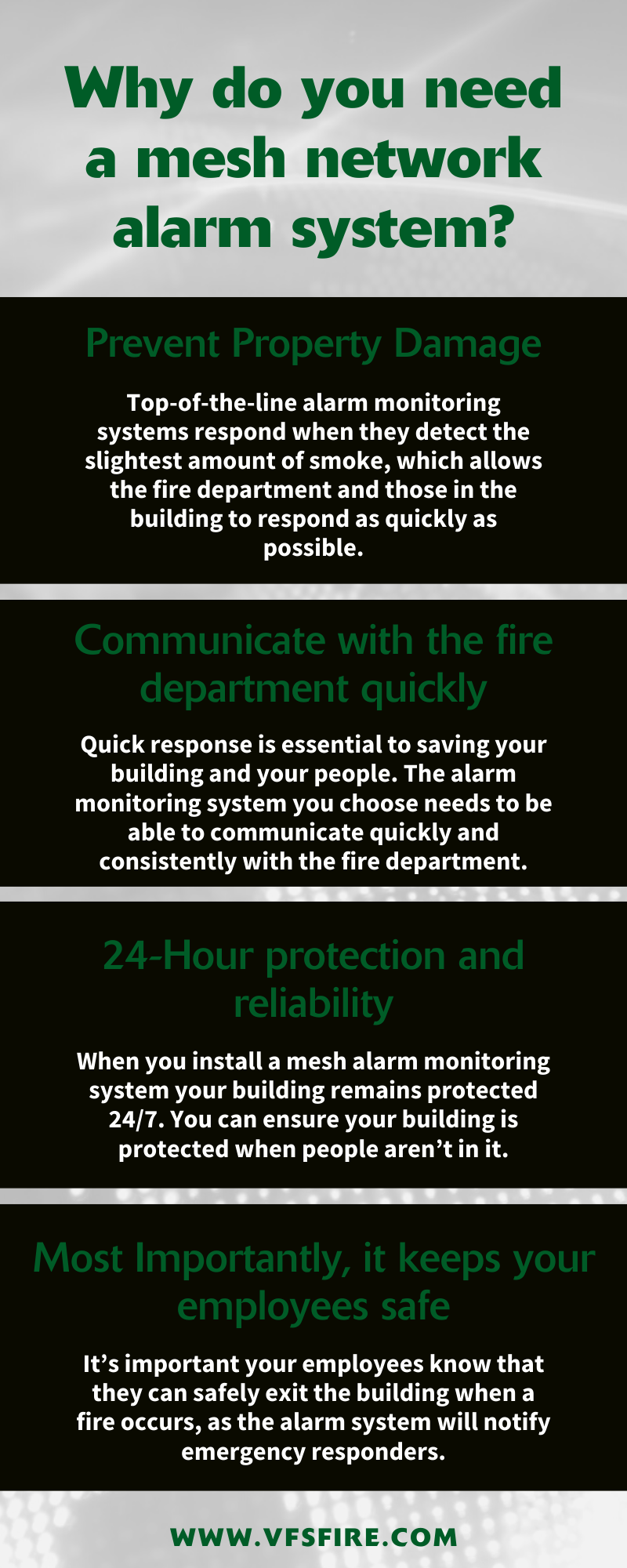
Why do you need a mesh network alarm system?

Prevent Property Damage

Top-of-the-line alarm monitoring systems respond when they detect the slightest amount of smoke, which allows the fire department and those in the building to respond as quickly as possible. Quick response times help you ensure that smoke doesn’t turn into a large fire. 

COMMUNICATE WITH THE FIRE DEPARTMENT QUICKLY

Quick response is essential to saving your building and your people. The alarm monitoring system you choose needs to be able to communicate quickly and consistently with the fire department. Instead of worrying about calling and reporting the fire, people inside can focus on evacuating the building and helping those in need.

24-HOUR PROTECTION AND RELIABILITY

When you install a mesh alarm monitoring system your building remains protected 24/7. You can ensure your building is protected when people aren’t in it. With mesh network systems, you can feel at ease that your building is safe especially during an emergency.

Cellular and IP systems tend to slow or drop as more users are added to the system. MeshWrx’s performance is actually improved when more users are added. Mesh networks create multiple pathways for an emergency signal to reach first responders. 

MOST IMPORTANTLY, IT KEEPS YOUR EMPLOYEES SAFE

Lastly, and most importantly, installing an alarm monitoring system ensures your employees remain safe. It’s important your employees know that they can safely exit the building when a fire occurs, as the alarm system will notify emergency responders. 
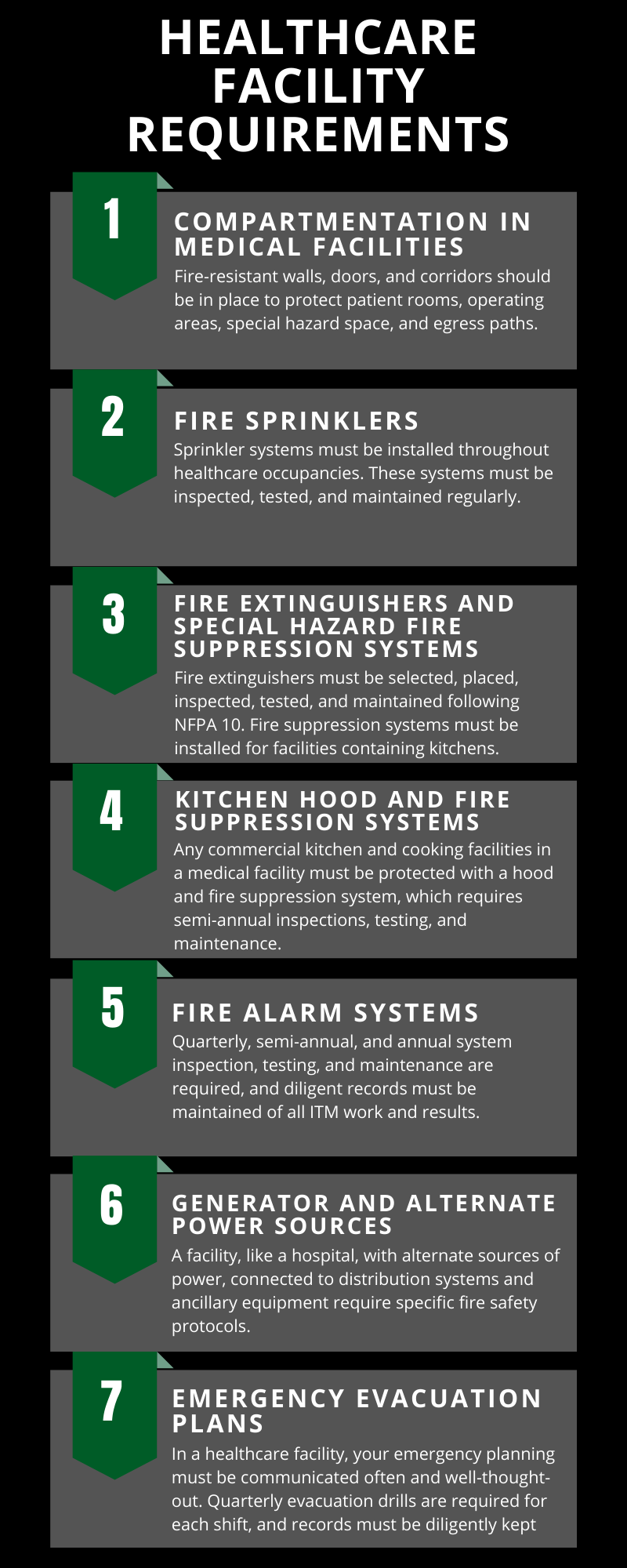
HEALTHCARE FACILITY FIRE SAFETY REQUIREMENTS

THIS ISN’T GREY’S ANATOMY- AVOID THE UNNECESSARY DRAMA AND ENSURE YOU HAVE PROPER FIRE PROTECTION IN PLACE

Paging Dr. Grey. Code Red. A fire has broken out in Grey-Sloan Hospital and all the patients and doctors are at risk. We know… you’re glued to your television. This is some intense drama. While yes, a fire in a hospital makes for a drama-filled, intense episode of Grey’s Anatomy, we don’t want that to become a reality for your healthcare facility. 

Healthcare facilities have greater requirements than most other facilities because they are governed by the Joint Commission. Because of these stringent requirements, hospitals need to be better equipped to withstand a sudden fire. You all hold lives in your hands every day and documentation is critical in your facilities to validate that you are upholding critical safety measures required by governing agencies such as NFPA and Joint Commission. 

HERE ARE A FEW OF THE REQUIREMENTS NEEDED FOR YOUR HEALTHCARE FACILITY. 

COMPARTMENTATION IN MEDICAL FACILITIES

Compartmentation typically utilizes a passive fire protection system that prevents or slows the spread of fire by walking it off. Fire-resistant walls, doors, and corridors should be in place to protect patient rooms, operating areas, special hazard space, and egress paths. 

FIRE SPRINKLERS

Sprinkler systems must be installed throughout healthcare occupancies. These systems must be inspected, tested, and maintained regularly. Major components should be inspected quarterly, semi-annually, and annually. Each of these inspections requires specific components to be maintained. 

FIRE EXTINGUISHERS AND SPECIAL HAZARD FIRE SUPPRESSION SYSTEMS

Any facility with a commercial kitchen or cooking facility requires hood and fire suppression systems to ensure fires don’t spread throughout the rest of the building. Fire extinguishers must be selected, placed, inspected, tested, and maintained following NFPA 10.

KITCHEN HOOD AND FIRE SUPPRESSION SYSTEMS

Any commercial kitchen and cooking facilities in a medical facility must be protected with a hood and fire suppression system, which requires semi-annual inspections, testing, and maintenance. Additionally, the filters and exhaust ductwork that make up the hood system require regular cleaning—the frequency of which is based on the amount of grease that is used in the cooking process. These specific requirements are outlined in NFPA 96: Standard for Ventilation Control and Fire Protection of Commercial Cooking Operations.

FIRE ALARM SYSTEMS

NFPA requires a fire alarm system throughout the facility. NFPA 72: National Fire Alarm and Signaling Code, outlines the installation and ITM requirements for these systems. A facility manager should understand the basic operation of fire alarms and what the various signals may mean. Quarterly, semi-annual, and annual system inspection, testing, and maintenance are required, and diligent records must be maintained of all ITM work and results.

GENERATOR AND ALTERNATE POWER SOURCES

A facility, like a hospital, with alternate sources of power, connected to distribution systems and ancillary equipment require specific fire safety protocols. Depending on your risk category your EES (Essential Electrical System) may change. Category 1 Requires Type 1 EES, Category 2 can use either Type 1 or Type 2 EES, Category 3 and 4 do not require and EES.

EMERGENCY EVACUATION PLANS

In a healthcare facility, your emergency planning must be communicated often and well-thought-out. Quarterly evacuation drills are required for each shift, and records must be diligently kept. General housekeeping of keeping egress paths clear, “no smoking” policies, decorated hallways and patient rooms should be fire-resistant, and soiled lines and trash should be regularly emptied is essential to communicate to your team. 

With all these requirements, it’s important to understand exactly what you need to do in order to keep your building safe from harm. Here are a few items on your checklist you need to go over.

FIRE PROTECTION OPERATIONS:

  • First and foremost, make sure your hazard emergency plans are in place and are well-thought-out for your specific building. Healthcare facilities must maintain emergency and evacuation plans, and employees must be regularly trained on these plans and their roles within them. Emergency plans should include instructions for fire emergencies and general building evacuations.
  • Once you have found your plan, make sure all employees are trained regularly, and that training is documented. Quarterly evacuation drills are required for each shift, and records of these drills must be maintained. Additionally, hospital staff should be aware of and sustain general housekeeping standards. These activities include maintaining clear access to exits, enforcing “no smoking” policies, making sure decorations in halls and patient rooms are fire resistant and do not exceed allowed limits, and ensuring soiled linens and trash are regularly emptied and not permitted to accumulate beyond allowed maximums (0.5 gallons per room, 32 gallons total in a protected area).
  • Make sure you conduct fire drills quarterly, and these drills are documented.
  • Are your “non-smoking” areas in place and enforced?

FIRE SPRINKLER SYSTEMS:

  • Fire sprinklers must be installed throughout healthcare occupancies. These systems are installed following NFPA 13: Standard for the Installation of Sprinkler Systems, and they are maintained according to NFPA 25: Standard for the Inspection, Testing, and Maintenance of Water-Based Fire Protection Systems.
  • NFPA 25 outlines the required inspection, testing, and maintenance (ITM) frequency and procedures. Major system components are required to be inspected quarterly, semi-annually, and annually. At each of these intervals, specific items must be maintained and tested. There are also weekly and monthly inspection requirements for items that must only be visually inspected—these components include gauges, valves, private hydrants, and fire pumps.
  • Monthly inspections of your fire sprinkler systems must be conducted and documented.
  • Quarterly, semi-annual, and annual inspection, testing, and maintenance should be conducted and documented. 
  • Five-year inspection, testing, and maintenance should be conducted and documented (if applicable)
  • Your fire hose should be tested and the testing should be documented.


FIRE PUMPS:

  • Pump runs should be conducted and documented on a weekly or monthly basis depending on type.
  • Annual pump testing should be conducted and documented.

FIRE ALARM SYSTEMS

  • Quarterly, semi-annual, and annual inspection, testing, and maintenance should be conducted and documented.

FIRE SUPPRESSION SYSTEMS:

  • The kitchen hood and ductwork should be cleaned regularly depending on your building (quarterly, semi-annually, or annually) and documented.
  • Your kitchen suppression system should be inspected, tested, and maintained semi-annually and the services should be documented. 

FIRE EXTINGUISHERS 

  • Monthly inspections of your fire extinguishers must be conducted and documented. 
  • Annual inspections by a licensed fire protection professional must be conducted and documented. Any deficiencies found from that inspection must be corrected and fire extinguishers must be certified. Inspection reports and repairs must be documented.
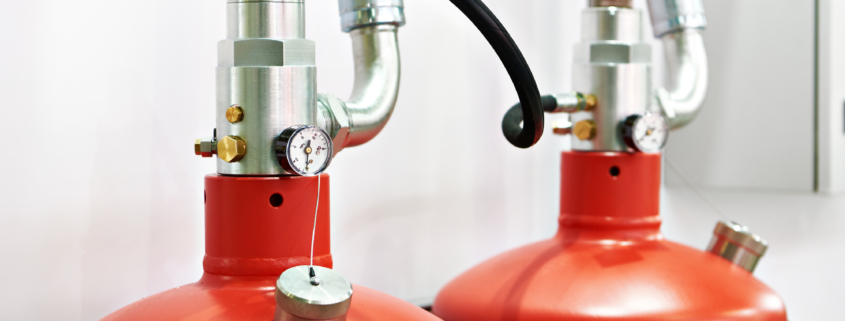
fire extinguishers in a fire suppression system

Did you know that a fire suppression system can help minimize damage caused by a fire in your business? Fire suppression systems are designed to quickly put out fires, which can help to save lives and property.


Although your fire protection needs vary based on the type of commercial building you own, you’ve likely heard of many distinctive fire protection systems. But do you know the key differences between a fire sprinkler system and a fire suppression system? It’s important to understand these differences as a business or building owner.


In this blog post, we will discuss the different types of fire suppression systems and how to maintain them. Let’s get started!


What Are the Basics of Fire Suppression Systems?

There are two main types of fire suppression systems: Wet and dry. Wet systems use water to extinguish a fire, while dry systems use chemicals. Each type of system has its own advantages and disadvantages.


Wet systems are typically more effective at putting out a fire than dry systems. However, wet systems can also cause more damage to property. This is because water can damage electronics and other sensitive equipment.


Dry systems, on the other hand, are less likely to cause damage to property but are not as effective at putting out a fire. Dry systems are ideal in locations that experience freezing temperatures and for buildings that house important items (for example, museums and libraries).


When choosing a fire suppression system, it is important to consider the type of business you have. For example, if you have a computer server room, you will want to choose a system that is designed for this type of environment (AKA a dry system!)


Additionally, you should consider:


  • The size of the space that needs to be protected, and
  • The level of protection your commercial building needs

Types of Fire Suppression Systems

It’s important for a business or building owner to be aware of the different types of fire suppression systems available. Specific fire suppression systems include the following:


Clean Agent Fire Suppression Systems

Clean agent fire suppression systems use environmentally-friendly chemical reagents to put out fires. These are typically found in sensitive areas, such as data centers. The chemicals used are water-free and safe for the environment. Once a clean agent system is activated, clean-up is minimal!


Carbon Dioxide Fire Suppression

Carbon dioxide systems use CO2—colorless, odorless gas—to extinguish a fire. These systems are an incredibly efficient and cost-effective approach to fire protection. Clean-up following the activation of a carbon dioxide system is minimal.


Carbon dioxide fire suppression systems are currently being used in commercial shipping applications by the U.S Navy. The engine rooms of marine vessels utilize CO₂ instead of water as a suppression agent because water would damage the electrical and mechanical components of the engine. Additionally you wouldn’t want to put water into a vessel that is already at sea. It is common to find these systems in industries that handle steel and aluminum as well.


Industrial Fire Suppression Systems

Industrial plants need extra attention when it comes to fire protection, as most of the areas are in high-hazard environments. The fires that occur in these areas typically involve some type of chemical, liquid fuel, or other hazardous materials. 


Therefore, proper fire protection systems are essential. Industrial fire suppression systems typically use dry chemicals to extinguish the fire.


Restaurant Fire Suppression Systems

Kitchens require specific fire suppression systems. Kitchen fire suppression systems are designed to put out grease fires that would be worsened if you attempt to put them out with water. They typically utilize wet chemicals in a mist form to extinguish the fire quickly and effectively.


The Importance of Inspection and Maintenance

Once you have chosen a fire suppression system, it is important to maintain it properly. This includes regularly testing the system and making sure it is working properly. Additionally, you should have a plan in place for what to do if the system fails.


These systems need to be kept up as they can freeze or experience corrosion, among other issues within the system. In order to prevent these systems from deteriorating, they need to be regularly maintained. This helps to keep your system in good working condition and can identify any potential problems before they become serious.


In addition to regular servicing, it’s important to keep an eye on your fire suppression system for any changes that might occur which could affect its performance. If you notice anything unusual, don’t hesitate to contact your service provider so they can investigate and carry out any necessary repairs!


When it comes to fire protection, it really can be a matter of life or death.


How Often Should I Check My Fire Suppression System?

Most people understand that they need to have their fire suppression systems inspected on a regular basis, however, they may not know how often these inspections need to be conducted.


The answer to this question is not always cut and dry, as there are a number of factors that can contribute to how often your system should be checked.


It’s important to have your system serviced at least once a year, in line with a regular Fire Risk Assessment, and even up to four times a year depending on the type of system.


If your business has a complex system or operates in a hostile environment, more frequent servicing may be required. 


One of the most important things to keep in mind when it comes to your fire suppression system is that you need to be sure you are staying code-compliant. 


Staying code-compliant means that you will need to adhere to the schedule set forth by the National Fire Protection Association (NFPA) as well as any other local codes that may be in place.


Additionally, your insurance company may have its own guidelines when it comes to how often your system should be inspected.


Another important consideration is the type of system you have in place. Different types of fire suppression systems will require different inspection schedules. Check out a detailed list from Associated Fire Protection to learn more about specific timelines.


By ensuring that your fire suppression system is regularly serviced and maintained, you can help ensure its reliability in the event of a fire.


Ensure Your Business is Protected from Fire!

Fire protection systems needed for high-hazard areas are among the most technical and specialized fire equipment systems. At VFS, we pride ourselves on being a renowned leader in the special hazards sector.


In fact, our founder and CEO, Randy Nelson, sits on the technical committee for NFPA 16 (Code Standard for the Installation of Foam-Water Sprinkler) and understands just how critical proper installation and maintenance are on these specialized systems.


We bring our robust knowledge, expertise, and experience to find the safest and most reliable solution for every unique need and environment your building has! If you have any questions about fire suppression systems or need help choosing the right one for your business, please contact our team at VFS Fire & Security Services today.


We’d be happy to help you find the perfect solution for your needs!

To learn more, check out our blog to see who can inspect your fire protection systems.

SPECIAL HAZARD FIRE PROTECTION

WE REALLY KNOW HOW TO SUCK THE AIR OF THE ROOM

You have likely heard the rumor that the Yale library’s fire extinguishing system removes the air from the book stacks in the event of a fire, which would doom anyone inside the building. While the special hazard fire protection system utilized is designed to save the books from harmful sprinklers, it actually will not harm anyone inside the building! This is only one example of how special hazard fire protection systems protect your people and your valuable assets. 

WHAT IS A ‘SPECIAL HAZARD’?

An area deemed a ‘special hazard’ area can mean a few things. For one, it can be an area containing equipment or processes of exceptionally high value. It can also be an area containing unique, or irreplaceable assets- like the Yale library! Lastly, they can be areas where the revenue produced or its function is of greater value than the equipment itself. 

A special hazard isn’t simply an area, it can be a building, area, room, or a piece of equipment. From a fire protection standpoint, certain industries bring about additional challenges in the fire safety realm. Places like data centers, telecommunications, power generation, manufacturing and testing facilities, machinery spaces, and healthcare facilities. A typical fire alarm and sprinkler system simply won’t cut it for these types of buildings. 

At VFS, we’re experts in special hazard protection. We know how to ensure your unique building needs are met in terms of fire protection. We also know that special hazard protection begins with fire suppression systems, sounds, and communication systems. 

FIRE SUPPRESSION SYSTEMS

Fire suppression systems are designed to extinguish or control fires. They are activated by heat, smoke, or a combination of the two. Unlike typical wet-pipe sprinkler systems, suppression systems use gaseous, chemical, or foam agents to suppress the fire. Like the Yale library- we know how to suck the air out of the room! 

Because these fire suppression systems do not utilize water, they aid in protecting and preserving sensitive equipment and content within a very specific environment. Specific environments typically need specific different types of fire suppression systems. At VFS, we have the expertise to design, install, and maintain these systems with integrity. A few of the major special hazard systems we provide our clients include portable fire extinguishers, pre-engineered systems, marine, vehicle, pre-engineered kitchen systems, and gaseous systems. 

SOUND AND COMMUNICATION SYSTEMS

In an emergency, especially in a special hazard situation, communication is key. These communication systems work with your fire protection systems to ensure the safety of your people. At VFS, we support our clients in crafting internal and external sound, text, and visual notifications sent from a centralized location. 

These notifications are based on the type and severity of the threat. As well as location tools that identify at-risk personnel and assets. It is essential to have top-of-the-line sound and communication systems that ensure the safety of your most valuable assets.

We are a renowned leader in fire and life safety systems for special hazard facilities. We take pride in being one of the select few companies capable of performing highly technical and sophisticated projects. Our clients have access to our team every step of the way. From the design/ build stages to the implementation. 

The robust knowledge and vast experience our team retains provide the best possible solutions for all clients. Our technical and design expertise is recognized nationally. Our CEO and Founder, Randy Nelson sits on the Technical Committee for NFPA 16 (Code Standard for Installation of Foam-Water Sprinkler), so you could say we know what we’re doing! If you need a partner in your fire protection, contact us today!

5 THINGS CRE OWNERS SHOULD KNOW ABOUT INSTALLING ERRCS

DON’T GET IRKED BY ERRCS

What happens when an emergency occurs in your building? Will people be able to communicate outside the building for help? Will they be guided to safety? Can the occupants dial 911 from their cell phones?

It’s important that first responders are able to communicate with other emergency responders outside of the building. As a building owner, it is your responsibility to manage evacuation, communication, and signal systems. 

Buildings are typically composed of materials that inhibit cellular and other communication signals. In order to boost signals within your building and ensure public safety compliance, you can utilize ERRCS systems. 

WHAT ARE ERRCS?

An Emergency Responder Radio Communication Systems (ERRCS) is a required standard for most buildings. ERRCS is a building communication system that improves communication within the building to those outside. This extension of the public safety network utilizes small antennas called Distributed Antenna Systems (DAS) that receive and transmit radio signals from the first-responder network. 

These ERRCS systems are composed of various components that ensure they are working efficiently and effectively. A Bi-Directional Amplifiers system is integrated to connect the smaller antennas to the donor antenna. This antenna then transmits and receives radio frequencies from the public safety network. 

ERRCS IS NOT REQUIRED FOR EVERY COMMERCIAL BUILDING. HOW CAN YOU DETERMINE WHEN YOU NEED TO INSTALL ERRCS?

Start by checking your local jurisdiction to see if there are ordinances in place that relate to public safety communications. The general requirements for all buildings is that public safety radios must work in the building. If public safety radios are tested and work successfully, especially in critical areas like stairwells, electrical rooms, mechanical rooms, and elevators, then you will not be required to install an ERRCS. 

It’s important to understand what might block these signals before you hire someone to test your communication capabilities. Exterior walls and glass are just the beginning when it comes to potential signal blockages. Interior walls, office furniture, equipment, and people can also impact signal transmission. 

WHEN ARE ERRCS REQUIRED?

There are various requirements for installing ERRCS in your commercial building. Here are a few of the common requirements you need to be aware of. 

BUILDING SIZE

Buildings that have 3 or more stories, are 50,000 square feet in area, or have underground parking require the installation of ERRCS. Buildings with complex layouts have a challenging time keeping the signal strength in all areas of the building.

Challenging layouts typically include thick walls and multi-room floors. If your building is made up of metal, concrete, brick, wood, or Low-E glass, the signal may be blocked or disrupted. In order to remain in compliance with IFC regulations, you must ensure the RF signal is amplified in all areas of the building. 

LICENSING REQUIREMENTS

It’s important to ensure your Federal Communications Commission licensed radiotelephone transmitters are adjusted, maintained, and repaired up to code. These services require special training, so it’s important that you hire a trusted resource to perform inspection and maintenance on your equipment. Our experts at VFS are trusted to ensure our clients remain in compliance and up to code. 

PAGING SYSTEMS

It is essential that your ERRCS work cohesively with your fire protection systems. In order for the two to work together, you need to implement paging systems. Paging systems help announce instructions to building occupants to ensure their safety. 

SIGNAL STRENGTH

In order to remain in compliance with ERRCS requirements, a building must have a 95% majority of minimum signal strength of -95 dBm. This level is a standard in emergency responder communication systems. In order to ensure this requirement is met, you may need to boost the signal through DAS or other signal boosters. 

SIGNAL TESTING

Annual testing and maintenance are required to ensure standards are met and any interference is kept to a minimum. VFS is licensed and certified to help your building remain in compliance with these testing and maintenance requirements.

BATTERY BACK-UPS

Battery back-ups are required in case of power outages. When an emergency occurs, the power may need to be cut off to all parts of the building. When your back-ups are reliable, you ensure your emergency systems are running when you need them most. 

Do you know if your building requires ERRCS to be implemented? If not, our experts can help! Contact our team today to see how we can help your building remain compliant and, more importantly, safe!

FIRE SAFETY TIPS FOR COMMERCIAL PROPERTY OWNERS

EYEWASH STATIONS ARE NOT JUST FOR GETTING DEL FUEGO OUT OF YOUR EYES (WE GET IT… WE LOVE TACO BELL TOO)

Commercial Property Owners: Ensuring your building remains safe from harm is essential to your ongoing success. The foundation of your building safety protocol is fire safety. According to Chad Connor at AZ Big Media, about 120,000 commercial property fires occurred in 2019, resulting in $4.3 billion in property damage, 1,200 injuries, and 110 deaths. In order to ensure your commercial property isn’t included in that number, you need to put the proper fire safety precautions in place. 

START WITH REGULAR INSPECTIONS

Safety alert lights, fire alarms, fire extinguishers, and sprinkler systems must be inspected on a regular basis. Each fire protection system requires a different maintenance schedule. It’s important to stay on top of your inspection schedule in order to ensure your property remains up to code and safe for its occupants. 

  • NFPA 25 Standard for the Inspection, Testing, and Maintenance of Water-Based Fire Protection Systems
  • NFPA 72 National Fire Alarm and Signaling Code
  • NFPA 10 Standard for Portable Fire Extinguishers
  • NFPA 17A Standard for Wet Chemical Extinguishing Systems (Kitchen Systems)
  • NFPA 17 Standard for Dry Chemical Extinguishing Systems (Paint Spray Booths)
  • NFPA 2001 Standard on Clean Agent Fire Extinguishing Systems

At VFS, we assist our clients in maintaining their inspection schedules to ensure ongoing fire and life safety success. As a business owner, it’s important that you or your facilities manager are present for all inspections. Knowing the overall health of your facility allows you to plan for future expenses and report accurate safety updates to your insurers. 

ENSURE YOU HAVE THE PROPER FIRE PROTECTION SYSTEMS IN PLACE FOR YOUR UNIQUE BUSINESS

Your commercial property is unique to the needs of your business. Similarly, the necessary fire protection is unique to your commercial property. Understanding what fire protection systems you need in place to ensure your building remains safe is essential. Here are a few fire protection systems you may need to consider:

  • Smoke management systems
  • Automatic closing doors
  • Private fire hydrants
  • Fire alarm systems
  • Communication systems
  • Emergency generator and standby power systems
  • Sprinkler Systems
  • Standpipe systems
  • Pressurized stair shaft
  • Elevators automatic Phase 1 & 2
  • Fire extinguishers
  • Fire pumps

MAINTAIN PROPER SIGNAGE THROUGHOUT THE BUILDING

Indoor and outdoor signage is essential to the safety of your building. Firefighters cannot do their job if they do not have access to equipment and pathways to access the emergency. Floors and rooms should be clearly mapped, access to specific areas like the roof should be clearly labeled, and fire safety equipment and hazardous materials need to be identified. 

Occupants cannot get to safety without understanding where the nearest exit is. Exit lighting can be an overlooked area of your fire safety. When a fire begins, the conditions will likely induce chaos and confusion. Smoke can cause occupants’ vision to be obscured and make it difficult to navigate around the office space. Ensure all exit signs are illuminated and easy to read. Consider auditory alerts as well as visual alerts for those who are visually impaired or in the case of heavy smoke. 

COMMUNICATE YOUR EMERGENCY ACTION PLAN WITH EMPLOYEES

Written emergency action plans are a vital part of ensuring your employees know what to do if an emergency occurs. These plans should cover actions both employers and employees should take to remain safe during fire emergencies. It should include the equipment that needs to be shut down, escape routes, and when and where manual fire suppression efforts should take place. 

Ensure the management team occupying your building reviews the emergency action plan with all employees at various times throughout their time in the building. It should be reviewed when it’s developed, when employee’s responsibilities change, and when the plan changes. 

ENSURE YOU HAVE SPECIAL HAZARD PROTECTION IN PLACE IF NECESSARY.

Special hazard protection is not a commonly discussed fire safety topic. Ensuring buildings are up to special hazard standards takes a very specialized skill set to perform. 

Custom fire and life safety doesn’t stop with fire suppression and sprinkler systems.   Emergency eyewash stations or emergency showers are a vital part of certain special hazardous situations.  In cases where chemicals are in play, eyewash stations are a critical safety element. 

At VFS, we pride ourselves on our expertise when it comes to special hazard protection. We understand that special hazard safety begins with the integration of custom fire sprinkler systems, special hazard solutions, and fire alarms. 

ACTIVE VS. PASSIVE FIRE PROTECTION

WHEN YOUR WIFE SAYS “I’M FINE…” HOW TO PUT OUT FIRES (BECAUSE YOUR RELATIONSHIP IS ABOUT TO GO UP IN FLAMES)

As a husband, the last thing you want to hear is your wife passive-aggressively saying “I’m fine…” You know exactly what that means- it’s time to put out a figurative fire because your relationship is about to go up in flames. As a building owner, the flames you need to avoid aren’t quite as figurative. 

In order to fight very real fires that can occur in your building, you need to implement proper fire protection systems. Both active and passive fire protection systems are necessary to keep your building, and more importantly, your people safe from harm. 

WHAT IS PASSIVE FIRE PROTECTION?

The word ‘passive’ has a connotation that the object in question is something that is not expected to produce results. Your wife’s passive-aggressive comments beg to differ, and so do your passive fire protection systems.  In fact, passive fire protection (pfp) can be equally, if not more, effective than active fire protection. 

Passive fire protection systems are stationary materials designed to prevent the spread of fire and smoke. These systems help keep the fire in its original area, therefore, stopping it from spreading throughout the building. The combination of active and passive fire protection systems can help put out fires faster and stop additional damage from occurring. 

These fire protection systems are typically built into your building. When looking to renovate or build on a property, there is a lot of careful planning needed to ensure your building has these passive fire protection systems in place. Our team can help your team design and plan your construction in order to ensure building safety. For example, using cinder block walls as opposed to traditional wood-frame walls help to reduce the spread of flames. 

However, passive systems can still be added after construction. Structures like smoke baffles, fire doors, and fire-resistant glass partitions can be installed after construction has been completed. 

The objective of a passive fire protection system is to hold the smoke and flames in one contained area. They can also be used to channel the flames out of the building. When you have passive fire protection systems in place, fires that do occur are easier to extinguish. 

WHAT IS ACTIVE FIRE PROTECTION?

With an active fire protection (afp) system, some kind of action is taking place. Whether it is manual or automatic, these systems deploy once fire, smoke, or heat is detected. These systems are designed to help combat the fire, and help put it out. 

MOST BUILDINGS ARE EQUIPPED WITH A FEW ACTIVE SYSTEMS THAT CAN BE DEPLOYED ONSITE DURING A FIRE.

SMOKE DETECTORS

Smoke detectors activate when there is smoke in the building. These detectors typically utilize noise and light to alert occupants in the building of the potential fire. 

FIRE EXTINGUISHERS

Are manually operated active fire protection measures. These help occupants put out small fires within the building. 

SPRINKLER SYSTEMS

Sprinkler systems are active fire protection systems that automatically activate to help put out the fire while building occupants move to safety. These systems trigger when the heat from the fire causes the sprinkler head to open. There are various types of fire sprinkler systems that can be beneficial for your business. 

Understanding your unique business needs is exactly what we do at VFS. Our in-house teams help with construction services, special hazard needs, inspection maintenance, and preventative maintenance. We are your partner in success. 

VENTILATION SYSTEMS

Ventilation systems help direct smoke out of the building and away from the occupants. 

These active fire protection systems are typically installed based on certain legal criteria such as occupancy and building size. Higher than average risk areas, such as areas with flames or cooking implements might require additional active systems for added protection. 

HOW DO PASSIVE AND ACTIVE FIRE PROTECTION MEASURES WORK TOGETHER?

A combined effort of passive and active systems is essential to the safety of your building and its occupants. Active systems effectively help occupants evacuate or fight the flames, these systems typically have a greater likelihood of error. 

Passive systems should be installed throughout the building as a way to support active systems. A great example of passive and active systems working together is smoke curtains. These passive fire protection systems help direct smoke toward vents, where smoke can leave the building. Passive systems can also help force flames and smoke to remain in one area.

New buildings should implement these passive fire protection systems into the design and build phase of construction. Our Design/Build team at VFS can help ensure your building is protected from harm when it is finished. Older buildings, which do not have these passive systems built-in, can be retrofitted with smoke curtains and panels as an added layer of protection. 

Active and passive fire protection systems together can prevent expensive damages, catastrophic injuries, and potential loss of life. Implementing both systems into your building is essential to the safety of your building. 

At VFS, we believe in helping your company meet the needs of your unique building. Every building is different, every building needs different protection systems in place. Our teams think creatively to come up with solutions that ensure your building remains safe from harm. Reach out to us today to see how we can help your business today! 

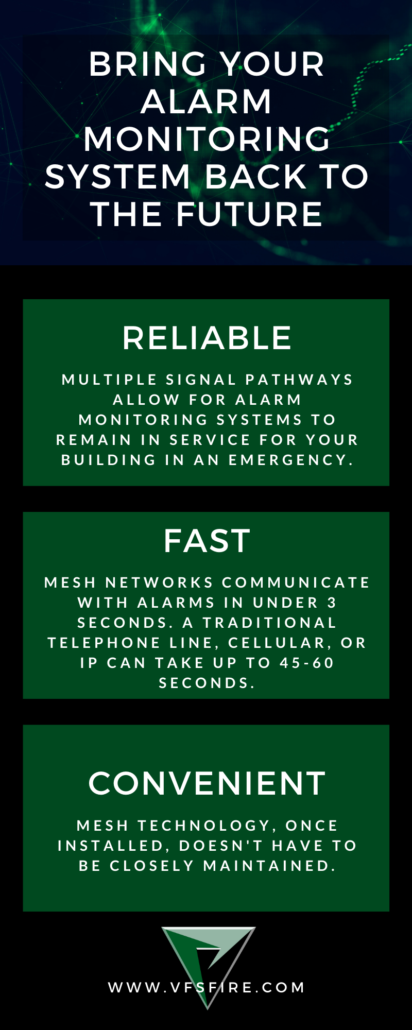
BRING YOUR ALARM MONITORING SYSTEMS BACK TO THE FUTURE

Great Scott! It’s time to bring your alarm monitoring systems back to the future. Mesh network systems are the Delorean ready to bring your systems up to speed with the times.

Choosing mesh technology to support your alarm monitoring system needs means choosing reliability, speed, and convenience. Your antiquated alarm monitoring systems just won’t cut it anymore. 

HOW CAN MESH ALARM MONITORING SYSTEMS HELP YOUR BUSINESS?

RELIABLE

Mesh network monitoring systems are unlike any tower-based, single-route systems. The mesh wireless technology is resistant to environmental disturbances and equipment problems. The multiple signal pathways allow for the alarm monitoring systems to remain in service for your building. 

FAST

Mesh networks communicate with alarms in under three seconds. A traditional telephone line, cellular, or IP can take up to 45-60 seconds. That extra time could be the difference between life and death for your employees. 

With mesh network systems, you don’t have to worry about slow or dropped connections. While cellular and IP systems slow and even sometimes drop when users are added to the systems, MeshWrx’s performance is improved. Radio mesh network technology creates multiple paths for an emergency signal to reach first responders. The self-configuration and smart routing results in 100% uptime. 

CONVENIENT 

Cellular and IP equipment requires consistent upgrades in order to ensure your technology does not become obsolete. With mesh technology, once installed, you don’t have to worry about it anymore. 

Not to mention the money you can save by installing mesh networks. Your current system may be costing you a small fortune. Monthly costs for traditional alarm monitoring systems are increasing as quality and reliability are decreasing.

Increased service calls and time spent tracking down issues are additional costs incurred with outdated systems. With MeshWrx, we eliminate the cost of expensive phone lines, don’t require upgrades, and instead provide more reliable technology.

MeshWrx alarm monitoring systems can help you protect your building when you need it most, just ask our clients! 

“Over the years we have had continued service issues and problems with our fire alarm monitoring telephone liens for our facilities in Southern California, and the cost and fees for phone lines have also increased year over year. By canceling our monthly fire alarm and security telephone lines services and going with MeshWrx monitoring, our organization is saving over $40,000 annually with superior technology, equipment, and service.” 

-Josh Harvey, Manager of Information Systems at Armstrong Garden Centers

One-resolution-you-cant-skip-out-on-is...-2

IT’S A NEW YEAR… YOU’VE ALREADY SKIPPED THE GYM DON’T SKIP ON YOUR FIRE PROTECTION. HERE’S A CHECKLIST TO HELP

We’re four days into the new year, if you haven’t already ditched your resolutions, you’re amazing. We’re not going to lie… we snuck a piece of chocolate cake after dinner last night. While a piece of chocolate cake, or a day off of the gym won’t seriously harm your wellbeing, there is one resolution you can’t forget about- fire protection for your building.

This year, it’s time to make fire protection a top priority. That being said, we’ve come up with a few items that should be on the top of your mind if you’re committed to fire safety. 

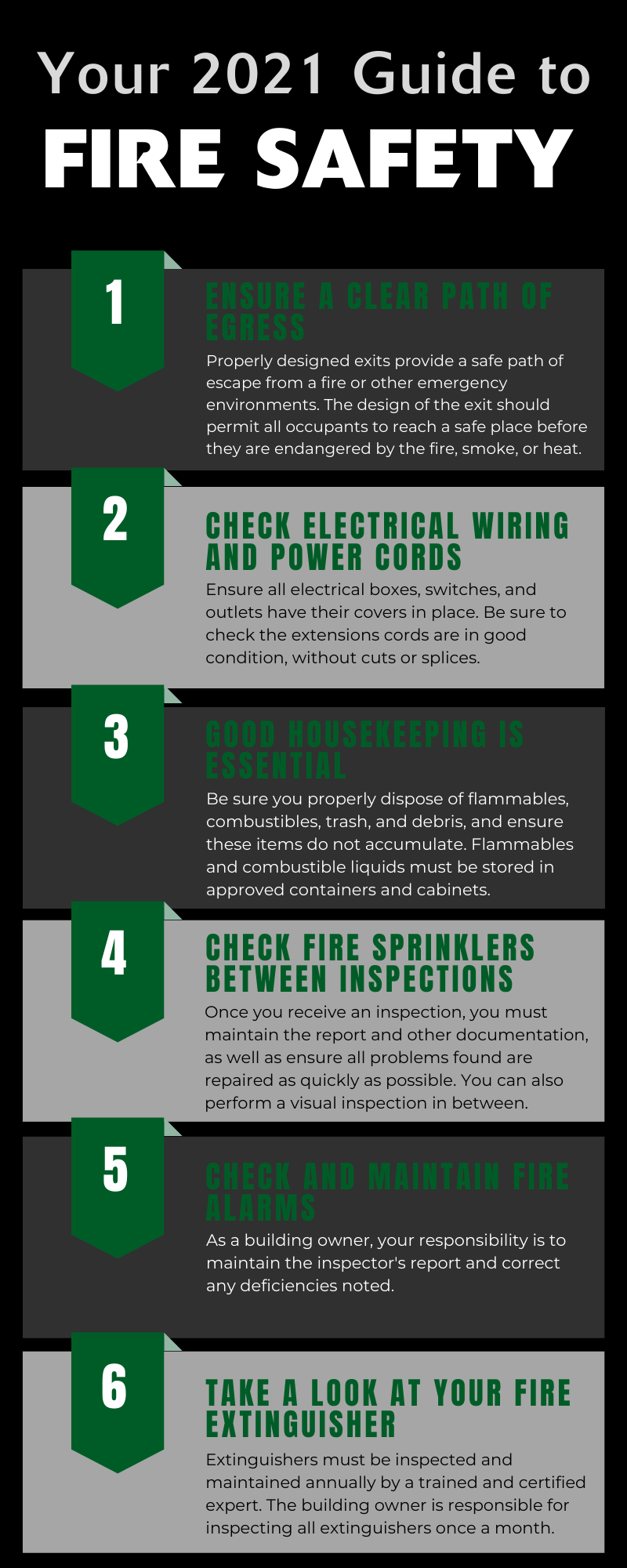
FIRST, ENSURE YOUR BUILDING HAS A CLEAR PATH OF EGRESS/ EXIT. 

Identifying the ‘means of egress’ from your building is essential to keeping your employees safe from harm. Properly designed exits provide a safe path of escape from a fire or other emergency environments. The design of the exit should permit all occupants to reach a safe place before they are endangered by fire, smoke, or heat. The goal of an effective means of egress is to get everyone out of hazardous areas in the shortest amount of time possible.

A FEW COMPONENTS MAKE UP THE MEANS OF EGRESS, INCLUDING EXIT ACCESS, EXIT, AND EXIT DISCHARGE.

  • Exit access is the travel path or area between where a person is located and an exit.
  • Exit is the portion of the means of egress that is separated by construction or equipment from other areas of the building. Components of an exit include walls, floors, doors, etc. An exit may include vertical or horizontal means of travel, like stairways, ramps, and passageways. It is important to note that elevators are not accepted as exits!
  • Exit discharge is the portion of a means of egress between the end of the exit and a public way or other safe places.

As a building manager or owner, it is important that you self-inspect these means of egress. In doing this, you need to make sure each component is easily identifiable, visible, accessible, and unobstructed. The door must operate in the direction of the exit so people won’t be trapped inside. 

NEXT, CHECK YOUR ELECTRICAL WIRING AND POWER CORDS.

NFPA 70: National Electrical Code (NEC) ensures all wiring and electrical installations comply with regulations. Building owners and managers do not need to be an expert in electrical code, however there are a few things you should be on the lookout for to be cautious!

The first thing you should do to ensure your electrical wiring is safe is to ensure all electrical boxes, switches, and outlets have their covers in place. Also, be sure to check that extension cords are in good condition and free of any cuts or splices. Extension cords should never be a substitute for permanent wiring, they are only permitted to be used with temporary equipment. 

Surge protectors must be connected directly to an outlet and, like extension cords, cannot be attached to the structure, extend through walls or the ceilings, be run under doors, or be covered by floor coverings.

The last item to check in the electrical wiring category is electrical panel boxes. Electrical panel boxes and main building disconnect must be identified and accessible for fire department personnel. All panels and breakers must be labeled and open spaces should have proper covers in place. 

GOOD HOUSEKEEPING IS ESSENTIAL– NO WE’RE NOT TALKING ABOUT DUSTING AND MOPPING. 

In the ‘fire safety’ sense, housekeeping refers to the general condition of the building and the items stored within it. Be sure you properly dispose of flammables, combustibles, trash, and debris, and ensure these items do not accumulate. Flammables and combustible liquids must be stored in approved containers and cabinets and should be clearly labeled to avoid accidental ignition. 

Electrical, boiler and HVAC rooms cannot be used for storage and must remain clear of items that are not essential to the operation of the equipment within them. 

ENSURE FIRE SPRINKLER SYSTEMS RUN EFFECTIVELY IN BETWEEN INSPECTIONS

Fire sprinkler systems must meet NFPA 25: Standard for the Inspection, Testing, and Maintenance of Water-based Fire Protection Systems requirements. These standards require that different parts of the sprinkler systems receive inspections in quarterly, semi-annual, annual, and five-year intervals. 

The inspections are performed by the fire protection contractors and other qualified personnel. As a building owner or manager, you do not have to directly handle any of the actual inspections. However, as a building owner, there are a few things you can do to ensure these inspections run efficiently and effectively, starting with scheduling the inspection appointments when due!

Once you receive an inspection, you must maintain the report and other documentation, as well as ensure all problems found are repaired as soon as possible. 

A building owner or manager can utilize a simple visual inspection to ensure these systems run effectively between inspections. First, ensure that no items are stored within 18” of any sprinkler head. Next, ensure all sprinkler heads are free of paint and corrosion and nothing is attached to them. If you come across violations of these requirements during your visual inspections, the issues should be reported and remedied immediately. 

FIRE ALARM MAINTENANCE AND INSPECTIONS

Under NFPA 72: National Fire Alarm and Signaling Code all fire alarm systems must be inspected, tested, and maintained at semi-annual, annual, and even quarterly intervals. Like sprinkler systems, these inspections are done by trained and certified inspection personnel. Fire alarm system experts are trained in the inspection, maintenance, and testing of a particular brand of fire alarm systems. 

As a building owner, your responsibility is to maintain all reports and correct any deficiencies noted. Building owners and managers can also make sure the fire alarm panel is accessible, the location is labeled, and all documentation is maintained and available. Manual pull stations should be visible and accessible. All alerts should be reported to the alarm company so that any issues can be addressed quickly. 

LASTLY, LOOK AT YOUR FIRE EXTINGUISHER. 

NFPA 10: Standard for Portable Fire Extinguishers illustrates the requirements to select, place, test, and maintain fire extinguishers. A trained and certified expert must perform annual inspection and maintenance. Additionally, building owners are responsible for inspecting all extinguishers once a month.

The inspection requires that extinguishers are visible and accessible. They must also be free of rust, damage, and the gauge read in the “green” operation level. Additionally, all extinguishers must mount on the wall. The weight of the extinguisher determines the appropriate height of placement: 40 lbs or less may be installed at 5 feet above the floor. Any heavier should sit at a maximum height of 3 ½ feet. The base must be at least 4 inches above the floor. 

As you look to ensure your fire safety in your building for the new year, start by utilizing this checklist! Ensuring you remain prepared for the unexpected is the first step to ensuring the safety of your people and your building’s safety.

Building security systems

SANTA’S COMING DOWN THE CHIMNEY, AND SO IS A BURGLAR. ARE YOU KEEPING AN EYE ON YOUR OFFICE WHILE EVERYBODY’S OUT?

Most people know that crime escalates around the holiday season. Whether it be burglary, cyberattacks, or theft, it’s important that your business is prepared for everything. Understanding the importance of implementing proper security measures into your building is essential to the safety of your team. 

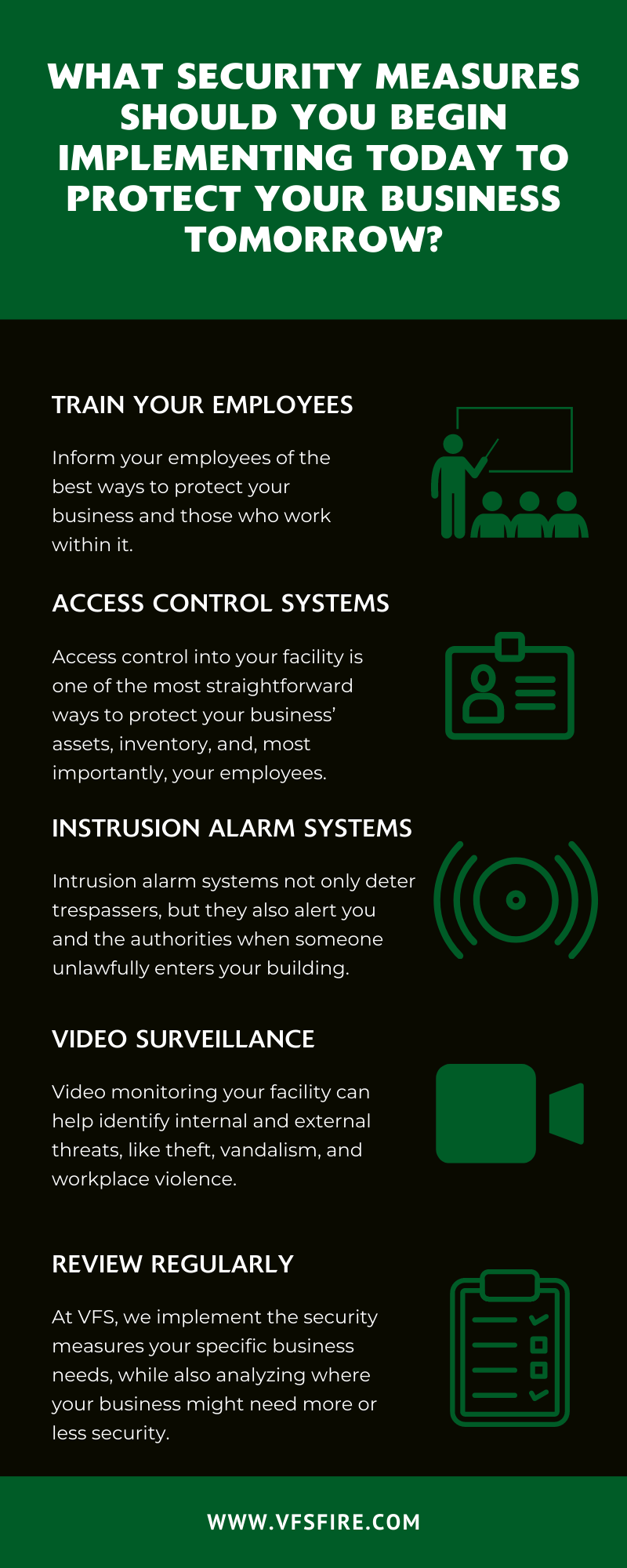
WHAT SECURITY MEASURES SHOULD YOU BEGIN IMPLEMENTING TODAY TO PROTECT YOUR BUSINESS LATER?

START BY TRAINING YOUR EMPLOYEES ON PROPER PROTOCOL.

Inform your employees of the best ways to protect your business and those who work within it. Security efforts throughout your company will not work if your employees are not on board. This training should cover physical security protocols. It should also cover what to do if someone dangerous is within the facility as well as cybersecurity protocols. 

Be sure your upper management has a large role in the implementation of security training and protocols. Upper management’s buy-in is essential. It helps ensure the rest of your staff understands the importance of the training. It also leads to greater follow-through with implementation.

ASIDE FROM EMPLOYEE EDUCATION, IMPLEMENT PROPER ACCESS CONTROL SYSTEMS.

Access control into your facility is one of the most straightforward ways to protect your business’ assets, inventory, and most importantly, your employees. An access control system that functions properly and is custom-tailored for your company is a powerful management tool. It helps to restrict access to certain rooms or track movement throughout your facility. 

At VFS, our security experts understand what it takes to implement proper security controls. We design access control systems that also integrate into your intrusion alarm systems.

ANOTHER ASPECT TO CONSIDER IMPLEMENTING IS INTRUSION ALARM SYSTEMS.

Intrusion alarm systems not only deter trespassers, but they also alert you and the authorities when someone unlawfully enters your building. Because every client has unique needs for their security measures, we design your security plan to meet your specific needs. VFS’ alarm systems integrate into your access control and video surveillance to ensure you are covered in the event of an emergency.

IMPLEMENT VIDEO SURVEILLANCE TECHNOLOGY TO PROTECT YOUR BUSINESS.

Video monitoring within your facility can help identify internal and external threats, like theft, vandalism, and workplace violence. Video surveillance deters people from actually performing these threats, while also making it easier to identify those that do. 

We connect your video surveillance system to your IP network. This means historical footage and live video can be viewed from a computer anywhere you have internet access. These systems can also work in conjunction with your access control system to ensure your business remains safe and secure.

Implementing video surveillance technology into your business’ security plans can also lower insurance premiums. As the insurance companies see it, your risk goes down immensely with proper security systems in place.

LASTLY, REVIEW YOUR SECURITY SYSTEMS AND PROTOCOLS REGULARLY.

At VFS, we implement security measures for your specific business needs. In doing this we also analyze where your business might need more or less security. We track each client’s activity and reliability using an in-depth reporting system.

These analytics dictate our recommendations and information on which systems you use the most. It also helps to inform us where your business has the potential to improve.

Understanding where your business’ security needs work is essential to keeping your people and your business safe from harm. When you have the proper systems and processes in place, you’re ready to handle anything that may come your way. Contact us today to learn more about how we can help your business remain safe and secure.