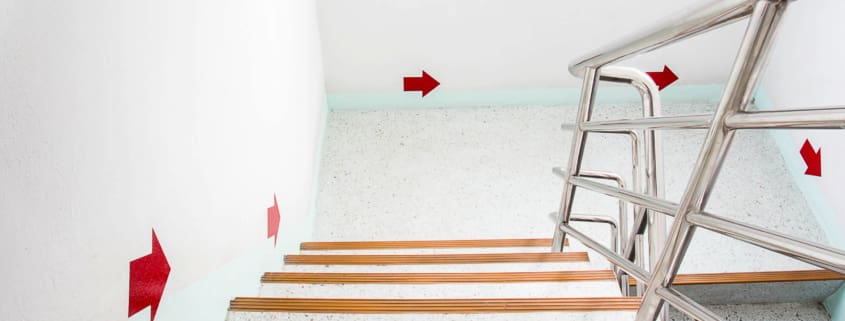
Building Compliance vs. Building Complaints (clearly marked fire exits)

Building Compliance vs. Building Complaints (Not a Spelling Error!)

There’s a good reason for the codes and standards established by the National Fire Protection Association (NFPA). Compliance isn’t a punishment, it’s a roadmap to safety, protection, and long-term sustainability.

With over 300 codes written in “legal-ese,” it’s not always as intuitive as it should be to comply with fire safety codes. So, we’ve created a cheat sheet to steer you in the right direction— it doesn’t have to be so overwhelming.

300 Fire Protection Compliance Codes?!?

Do you think you know them all? If you dare, check out our latest quiz to test your fire code knowledge. 

Unless you score perfectly on the fire safety quiz, it’s likely that your building does not have to comply with all 300 NFPA codes and standards. Searching the NFPA’s database here can simplify the process.

Codes you’ll regularly encounter, however, might include: 

NFPA 99

Health Care Facilities Code

NFPA 72®

National Fire Alarm and Signaling Code®

And others that are very specific, such as: 

NFPA 418

Standard for Heliports

Compliance isn’t the goal. Safety is the goal, and—in that vein—we always recommend the following precautions be taken.

Dispose of Excess Packaging in Real-Time

It seems like the stuff of action moves, and yet, it happens all the time. Piles of boxes can fuel a fire that might otherwise be easily managed. Oily rags can spontaneously combust. Rag disposal is essential to safety. Ensure you dispose of excess packaging in real-time.

Don’t Put a Lantern in the Shed with The Cow. 

Check your fire extinguishers. An expired extinguisher is not only frustrating, but it can be deadly. A popping sound when you turn on the light is a warning! Inspect electric lines that are old or unreliable. These tips and tricks might all seem out of pocket, but one day you might thank us for not putting that lantern next to your beloved cow, Betty. 

Get Honest Regarding our Disaster Preparedness

Whether it be for fire, earthquake, flood, locusts, and any other eventuality, get honest about your current disaster preparedness.

If you haven’t already, make sure everyone knows what to do, who is in charge, how to get out, and where to go following. This is a serious one for anyone who owns a business in California especially. The earthquakes have already started and don’t seem to be slowing down. 

Bring in the VFS Experts

We’ve seen it all. Our teams can ensure compliance and that it isn’t all you’re doing to prevent fires. We are a full fire and life safety contractor and after-market service, provider. Whether your fire prevention needs are related to fire sprinkler systems, alarms systems, extinguishers, backflows, fire pumps, suppression, special hazards, monitoring, DAS systems, emergency notification (the list goes on and on!), we can not only inspect and maintain those systems but also design, build, and install! With our inspections program, we manage, schedule, and track your inspections, deficiencies, and repairs so you don’t have to. 

At VFS Fire & Security Services, we pride ourselves on the caliber of our team members, our commitment to a holistic understanding of your needs, and our-list wine collection (get to know our founder!). We are the team you want to bring to your project.  Connect with us, take a look inside our new site!
VFS is your partner from start to finish: A walk through the onboarding process

Maybe you’re on the fence about hiring VFS. Maybe even wondering, “How would VFS go about onboarding my company into fire protection services?”

We offer a wide variety of services, so here’s a timeline of our involvement, and remember, we partner with you from START TO FINISH (not an exaggeration). 

Since you’re on our website, odds are you need help with fire protection services. This is a smart move for you as we approach fire season. Great news, you’ve already completed the first step! By simply showing interest in protecting your commercial property and employees. 

Free Consultation

Yes, you read that right. A FREE consultation, a hard offer to pass up. Click here to schedule your consultation today. It’s as simple as having a quick conversation with one of our fire protection experts to identify your unique needs.  

Who We Serve 

No matter the industry, VFS has you covered. From our dispatch team to our field technicians we are equipped with a full staff of fire protection experts and a robust knowledge of each specialized environment. We are constantly staying up to date on emerging trends in technology as well as new requirements and code changes to keep you informed and in compliance. Here are some of the markets we help to protect: 

  • Property Management 
  • Industrial & Manufacturing 
  • Oil & Gas
  • Transportation 
  • Retail 
  • Education 
  • Data Centers
  • Hospitality 
  • Healthcare 

The Specifics

Once we’ve decided that our companies will be a great fit as partners, it’s time to get down to the nitty-gritty. We offer a variety of services for all of your fire protection systems including the following: 

  • Service & Repair 
  • Testing & Inspection
  • Design/Build 
  • Retrofits
  • System Upgrades 

Just to name a few. 

How We Help 

At VFS we believe in a proactive business model. We manage the who, what, why and where of your fire protection assets and their inspection and maintenance schedule. It is essential to stay on top of your fire protection systems to prevent any potential accidents or costly repairs. 

Our advanced platforms and highly trained dispatch team allow us to manage inspections and testing from inception to execution. We tell you what’s due, when it’s due and why it’s due, and are constantly communicating to your team to keep you up-to-date on the latest information within your facilities. Fortify your building with reliable fire protection systems inspected and maintained by the experts at VFS

Once we help you decide which of our services are right for you, it’s go time. Visit the VFS website today for more information on becoming a partner. 

Prepping your commercial property for fire season! (Yes, you need to)

Surprise, fire season is just around the corner, which means it’s time to spring into action to prevent fires. 


As summer approaches, hot weather and dry winds create the perfect conditions for a fire that could destroy your property. 


Duh Duh Duhhhh!


Last year, in California alone, the state reported


  • 2.5 million acres burned 
  • 8,835 incidents 
  • 3,629 structures damaged or destroyed. 


Erring on the side of caution when it comes to protecting your commercial property can help prevent damage to your building. 


Your commercial property can suffer damage from a fire through:


  • Flames directly contacting your building 
  • Radiant heat that can cause combustible materials to ignite 
  • The wind blowing burning embers onto your property (the most common occurrence)


Fire season is unpredictable and frightening, but don’t worry, VFS is here to help prepare your commercial property for a potential emergency. Fire safety regulations for a commercial building may look different from one property to another. 


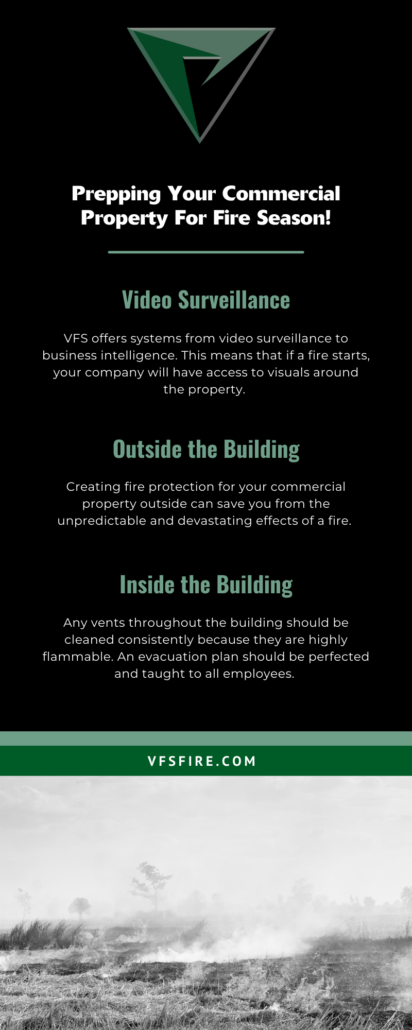
Video Surveillance


VFS offers systems from video surveillance to business intelligence. This means that if a fire starts, your company will have access to visuals around the property. We design systems that optimize your existing infrastructure and augment them with the latest in proven technologies. 


Adding this extra layer of security is just a stepping stone towards having a foolproof plan in place for fire season. 


Outside the Building

Establishing fire protection elements outside your commercial property may save you from the unpredictable and devastating effects of a fire. When preparing the surrounding area for fire season, create three “buffer zones” that act as lines of defense. These areas outside of the building need to be free of flammable or combustible materials. 


Zone Three

Typically, this region is the first line of defense against a fire. It ranges about 100 or more feet from the building depending on where the building is located.  In the case of commercial properties built on a slope, buffer zones are recommended to extend further, about 150-200 feet total, due to faster and longer flaming fires. This buffer zone would help slow down the pace of the fire.


The surrounding area of any property should be cleared of extra brush, dead plants, and trees. This includes trees, shrubs, bushes, and dead grass. Keep shrubs trimmed and spaced out as well. Another good rule of thumb to follow is to make sure any tree branches stay at least 10 feet from any other trees. 

If you need to keep a storage shed, wood, a trailer or other similar objects on your property, try to keep them in this zone. 

Zone Two

This is the second line of defense against a fire. Its purpose is preventative damage control if the fire breaks through zone three. Zone two ranges about 30 to 100 feet from the building. 


Buildings with grass surrounding the property should avoid tall grasses, also known as ladder fuels, because they make it easier for fires to climb trees. Any grass should be kept no taller than four inches high. 


Any dead plants, bushes, or trees should be removed from this area. When maintaining the trees in this zone, prune the branches so they are at least ten feet from the ground, and remove any low-hanging branches. 


Zone One

Zone one, also known as the last line of defense, includes the area up to 30 feet away from your property. 


If your building has a deck or a porch, avoid storing any combustible materials like wood underneath it. 


All dry or dead plants or dry vegetation in this zone must be cleared away. This includes:


  • Brush 
  • Bushes 
  • Pine needles 
  • Dry leaves 


When landscaping this area, it’s important to keep zone one in mind. It’s best to use noncombustible materials such as rocks or gravel to help keep flames at bay.


Cut down any tree branches hanging over the roof of the building. 

Other Outside Hazards

Another hazard to be aware of is gutters. The key is to maintain a consistent routine of cleaning out the building gutters to avoid the build-up of dry leaves and other highly flammable materials. 


The parking lot is another focus area for fire prevention. Depending on the commercial building layout, parking lots can become a hotspot for sparks to fly. To avoid this, inform your staff that they need to avoid parking over any grass or spilled oil.


Inside the Building


There are other steps beyond video surveillance that you can take to ensure your commercial building is prepped for fire season. 


Any vents throughout the building should be cleaned consistently because they are highly flammable. Metal vents can be added to act as a temporary barrier between embers and the vent. 


An evacuation plan should be perfected and taught to all employees. Performing practice drills with your company will ensure everyone understands their role in the event of an emergency. 


Get prepared for fire season before it starts this year. We promise you’ll thank us later. For more information about fire prevention vs fire protection, read our article here. 


prep for fire season
Get it together and inspect your building more than once a year!

You’ll thank us later. 

Owning a commercial building comes with a lot of responsibilities — that doesn’t mean you should slack on simple inspections. 

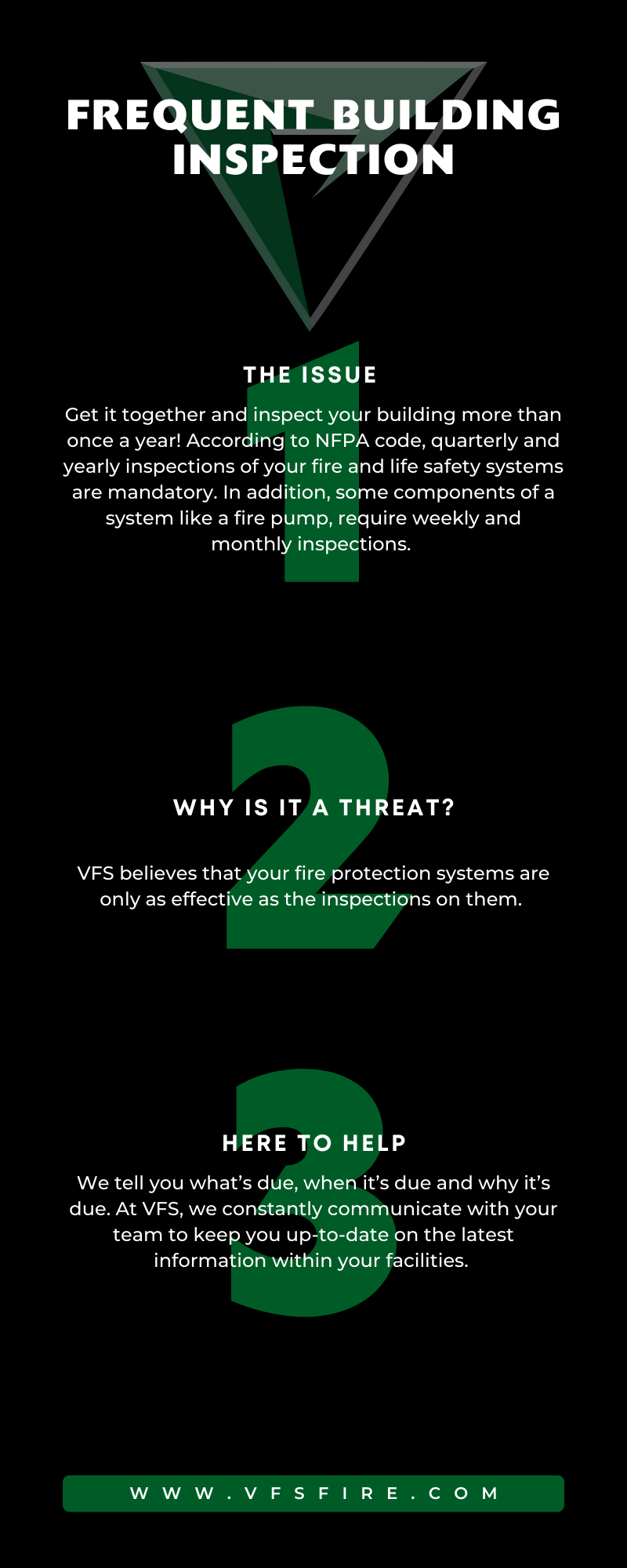
VFS believes that your fire protection systems are only as effective as the inspections on them. 

According to the National Fire Protection Association (NFPA) code, quarterly and yearly inspections of your fire and life safety systems are mandatory. In addition, some components of a system, like a fire pump, require weekly and monthly inspections. 

It is best to consult your VFS Account Executive for details. Having your building inspected by trained and certified inspectors will help keep your safety systems in good working order.

Hot Inspection Tips

  1. Annual inspections are required for all fire and life safety systems. But, once a year isn’t the best option for overall safety of employees and the buildings. 
  1. Some systems or components of a system may require more frequent inspections like monthly or quarterly. 
  1. Inspectors should be certified by a nationally recognized organization.
    • Inspectors should wear company clothing or nametags identifying them as professionals authorized to be in the building.
  1. Your inspection reports should deliver the following information:
    • Location of every device in building
    • Whether each device passed or failed inspection and why
    • Date/time stamp when each device was inspected
    • Device inventory & warranty status
    • Indication of length of time devices have been in service
    • Verification of report results
  1. Detailed inspection reports are excellent supporting documents for insurance companies or authorities having jurisdiction (AHJs).
  1. Make sure your employees or building tenants are aware of a scheduled inspection 24 hours in advance.
    • For Fire Alarm Systems, audio/visual testing may interfere with trainings, meetings or site visits.
  1. Let inspectors know of any construction or remodeling, and additions or problems to the fire protection systems in your building since the last inspection.

We tell you what’s due, when it’s due and why it’s due. At VFS, we constantly communicate with your team to keep you up-to-date on the latest information within your facilities. Fortify your building with reliable fire protection systems inspected and maintained by the experts at VFS!

It's summer vacation ... but not for you. Get your fire safety up to par

The sun is out, the air smells like sunscreen and … summer school! 

School buildings provide an important space for youth and educators, so there is great risk if there is no evacuation plan in place. 

Seems overwhelming? Don’t worry, the best part is that we do the work for you! 

Evacuation Plan

There are other outlier factors that need to be considered while creating a solid evacuation plan. National Fire Protection Association (NFPA) provides some startling facts about fires that start in school buildings: 

  • “School fires most often originated in a lavatory or locker room
  • Fires that were intentionally set were the leading cause of school fires, accounting for almost two of every five fires
  • Two-thirds of school fires occurred between 8 a.m. and 4 p.m. 
  • In 2014-2018, the U.S. fire departments responded to an estimated average of 3,230 structure fires in schools each year
  • These fires caused annual averages of one civilian death, 39 civilian injuries, and $37 million in direct property damage.” 

Since most fires start in locker rooms and bathrooms, the evacuation plan must be centered around those geographical locations. This will look different for each educational building based on the layout of the property. 

Draw a Floor Plan

When making a blueprint of the building, highlight exits and other fire safety tools (think fire hoses, extinguishers, and emergency phones). Make sure all staff know this plan inside and out, so in case of an emergency everyone’s prepared with the evacuation plan. 

More Tips

Cluing in students at an educational facility is also important to successfully follow through an evacuation plan. Assemblies and test fire alarms are a great way to start. 

Another option is to have posters around the educational building with reminders of fire safety tips and what to do in an evacuation. Some of these may include: 

  • Don’t use the elevator, always choose the stairs
  • Never go back into the building unless given permission by authorities
  • Call 911 as soon as possible
  • Always leave through the nearest exit
  • Leave your personal items behind

We protect property and lives, while providing a sense of security and peace of mind. 

VFS is here to help you improve your fire safety plan in educational buildings, find more on our website.  

Sound and Communication vs. Alarm and Detection... what?

Communication is key, especially in an emergency situation. The type of communication used is also an important factor in ensuring your building and, more importantly, your people remain safe from harm. 

When it comes to alarm & detection and sound & communication, it’s important to understand what your unique building needs in order to remain safe. 

Sound and Communication

Your building requires sound and communication systems that work cohesively with your fire and security systems. These should include internal and external sound, text, and visual notifications that are sent from a centralized location. At VFS, our clients have access to:

  • Localized notifications based on the type and severity of the threat
  • Emergency responder notification systems
  • Location tools to identify at-risk personnel and assets
  • Two-way voice communication for loud environments
  • Code compliance tools and support

There are a few different types of sound and communication systems that you can implement. 

Emergency communications

These notification systems are customized for your specific needs and location size. These include audible and visual notifications and text displays. These communication systems are used to alert people of events like natural disasters, fires, active shooters, and other emergency events. At VFS, we offer our clients emergency voice systems, fire alarm voice systems, visual strobes, and visual displays. 

PA and Intercom

These solutions can be utilized in multi-level buildings, campuses, warehouses and factories, airports, restaurants, and other shared-use spaces. PA and Intercom sound and communication systems can be live or pre-recorded, and offer 2-way communication through the speaker systems. These systems also allow for programmatic distribution, as well as audio transmission using LAN/WAN and internet connectivity.

Telephone Networks

Telephone networks are a sound and communication system that should not be overlooked. These systems help with communication on and off-site through telephone networks, as well as transferring calls off-site in case of incapacity of a site location.  Telephone networks can be integrated with these systems to incorporate intercoms, microphones, and loudspeakers. 

Wireless networks

Wireless networks utilize app-based technologies to remain in contact with on and off-site workers using existing wireless handsets. These networks allow alerts and emergency notifications to be delivered in real-time and integrated with other alert systems.

EVACs

EVAC systems are an extremely reliable option as they can be used when voice communication is not required by code. Voice alerts have a higher success rate of getting people out of the building, therefore it’s important to share accurate, specific information that reinforces the evacuation instructions and increases evacuation response time and adherence.

Alarm and Detection

Alarm and detection systems, on the other hand, are designed to discover fires early in their development while there is still time for evacuation. Fire alarm and detection systems work together to detect the fire and then alert people when smoke/fire is present through smoke detection, heat detection, or manual pull stations. 

Inspection, testing, and maintenance are crucial to the success of your alarm system. 

Pull Stations

Pull stations are a manual version of fire alarm systems that are triggered by people in the building. The pulled alarm station triggers the alert for the building as well as necessary authorities. These stations are typically located in fire-prone areas, like electrical rooms and mechanical workshops. 

Visual Alarm Systems

These alarm systems are flashing lights that are used to signal to occupants that there is a fire. These can be used in both self-contained units, as well as building-wide systems. ADAAG requires that when fire detection systems are installed, they must have a visual component. 

Audible Alarm Systems

There are a few options when it comes to audible alarm systems. These include air horns, sirens, bells, buzzers, and speakers. 

Flame Detection

Infrared flame detectors use charge-coupled devices (CCD) to identify fire. On the other hand, ultraviolet detectors work with wavelengths shorter than 300nm. These detect fires and explosions within 3-4 milliseconds. With UV detectors, false alarms are more commonly triggered due to UV sources, like lightning, arc welding, radiation, and sunlight. 

Smoke Detection

Smoke detectors are electronic fire protection devices that automatically sense the presence of smoke and sound a warning to building occupants. Smoke detectors used in commercial and industrial properties issue a signal to a fire alarm control panel as part of the building’s central fire alarm system.

Heat Detection

Lastly, heat detection devices detect heat rather than smoke. These devices are extremely beneficial in areas where other means of detection may be damaging or inefficient for your unique building. 

VFS is a nationwide source for exemplary fire and security services for commercial buildings, and special hazards. Our teams work with the most advanced technologies and systems to create intelligent, efficient fire and life safety solutions.

WHY DOES YOUR BUILDING NEED PREVENTATIVE MAINTENANCE?

Preventative fire and life safety system maintenance can save your building costly repairs.  More importantly, it can keep your people safe from faulty equipment accidents.

Why does your building need preventative maintenance inspections?

Your building occupants’ safety and wellbeing is your top priority as a building owner. Fires and other incidents are unpredictable, but you should prepare for the possibility they do occur. In order to stay properly prepared for emergencies, regular fire system inspections are essential. You need to know when your systems are faulty, in order to fix them before potential emergencies occur. 

The National Fire Protection Association, your local authorities who have jurisdiction, and the International Code Council implement fines for not following inspection standards. Fines and penalties, however, are the least of your worries if your alarm, sprinkler, or fire suppression systems don’t work when you need them.

How else can fire system inspection help your business?

With ongoing fire preventative maintenance, you create a safer work environment for your employees. Your employees won’t fear the danger of a fire breaking out in the office, because your systems will be running efficiently and effectively. Because of this, your employees, visitors, and customers will have a greater sense of security.

Your employees will also be able to be more productive. Not to mention, avoiding costly long-term losses and limited operations in a building that has experienced fire. 

Fire system inspections can also prevent your business from paying large fees for noncompliance, as stated above. When you perform preventative maintenance on your systems, you mitigate the cost of replacing unmaintained, corroded, or damaged equipment.

What types of fire systems need inspection and maintenance?

Your fire inspection requirements will vary depending on your facility, the state you operate in, and the various fire protection systems within your building. The type of preventative maintenance varies based on the type of fire system. The NFPA and ICC require that these systems receive an inspection regularly as follows: 

Fire Sprinkler Systems

These systems require weekly, employee inspections for dry, pre-action, deluge systems gauges, and control valves. Monthly employee inspections for wet pipe system gauges, and alarm valves.

Annual professional inspections are required for specific pieces of equipment. They are required for the building, hanger/seismic bracing, pipes/fittings, and sprinkler heads. Along with information signage, spare sprinkler heads, pre-action/deluge valves, dry pipe valves, and backflow prevention assemblies.

Lastly, they require a 5-year inspection for internal inspection of sprinkler piping, obstructions, and a valve check. 

Backflow Preventer Assemblies

Backflow preventer assemblies require a licensed sprinkler inspection company to inspect these systems annually. These inspections ensure your facility’s drinking water is safe and to ensure the sprinkler systems work properly.

Fire Suppression Systems

These non-water based fire suppression systems require a bi-annual inspection by a licensed fire protection technician. These inspections ensure there is the proper amount of clean agent available, the container is pressurized, and there is no damage to the container. 

Kitchen Hood Suppression Systems 

A licensed fire protection company must inspect your kitchen hood fire suppression systems every 6 months. These inspections are done to ensure your suppression systems will activate in the event of a fire. It ensure they put the fire out and shut off the gas or electricity used to run the equipment.

Fire Alarms

Routine maintenance is required by a trained employee must inspect the fire alarm components, control panels, power supplies, fuses, LEDs, and trouble signals once a week. They must also inspect the batteries for corrosion once a month. A licensed technician must inspect the initiating devices (heat, smoke, dust detectors) semi-annually. They must also inspect all the fire components and equipment once a year. 

Fire Extinguishers

Fire extinguishers require monthly inspections to ensure the pressure gauge is on full, the hose is intact, and the pin is secure. A certified professional must inspect the fire extinguishers yearly. 

At VFS, we provide inspections, testing, and maintenance of fire sprinklers and fire alarm systems. Our trained personnel conduct all inspections as outlined by the requirements of NFPA. As well as abiding by the local codes that apply to your specific area of operation.

With VFS, your preventative maintenance is top-of-mind. Your inspections will always be up to code and easy to access and schedule with our team!

HIGH-RISK, HIGH REWARD? NOT WHEN IT COMES TO FIRE SAFETY! (NOT A CANNABIS REFERENCE)

When it comes to buildings that contain flammable chemicals, gases, and other materials, fire protection is not something to gamble with. Not only will top-of-the-line fire protection keep your building safe, but it will also ensure that workers remain safe from harm. In this high-risk industry, it is essential that you don’t roll the dice on fire safety measures. 

According to OSHA, from 2013 to 2017, 489 oil and gas extraction workers were killed on the job. Getting your fire protection systems in check is like having pocket aces, it sets you up for the greatest success possible. Here are a few tips for you to begin prioritizing your fire safety protocols. 

Assess workplace preparedness

It’s essential to start with an inspection of your fire safety. These inspections lead to a greater understanding of your preparedness, and typically reveal vulnerabilities that you were previously unaware of. During this inspection, be sure to look for particular areas that have a higher risk for flash fires and explosions. 

You should also be on the lookout for fire equipment that is old or malfunctioning, and be sure to replace them with ones that are in good working condition. Not only should you look for vulnerabilities in your fire extinguishers, but also in your fire sprinkler systems. 

A great preventative measure is doing your own monthly visual inspections, as there are developments that can occur between the required NFPA inspections. Grab a notepad, take a walk and canvas your facility looking for any obvious visual deficiencies – corrosion, leaks, obstructions or painted sprinkler heads. With any luck you’re clear of any obvious deficiencies but if you’re not, call your fire protection company (hopefully VFS) to get these assessed and repaired preemptively. A little proactive measure can go a long way to prevent unnecessary accidents and keep your systems working in prime condition. 

Ensure emergency equipment is accessible onsite

With workers coming in and out of your facility, it’s important to have a supply of emergency equipment at their workstations and other areas near these stations. The equipment should include materials like fixed and portable fire extinguishers. This helps ensure the safety of your workers, as well as allows your employees to put out a small fire before it begins to spread. 

Ensure workers are trained to utilize equipment

In order to ensure your plan is effective, you must train your employees to know what to do in the event of a fire. They should receive instructional materials for the tools they may need to use, as well as participate in training that shows them how to physically use the equipment, and how to exit the building in case of emergency. 

Part of this training should include fire drills that help to reinforce the safety procedures and educate your workers on how to exit the building. You should also ensure all evacuation signage and exits are clearly marked, enough to see in the event of a fire. 

Utilize detection equipment to measure gas levels

In the oil and gas industry, it is essential to monitor the gas levels throughout your building. Combustible and toxic gas detection systems can help ensure your team avoids activities that may trigger a fire to occur. If a flammable gas goes beyond 10% of the lower explosive level, your workers should refrain from working. Ensure your employees know what levels are acceptable to remain working in, and which gases may be potentially hazardous. 

Ensure alert systems are installed to communicate fire risks

Lastly, ensure you have alert systems in place to communicate with your workers regarding the safety hazards throughout the facility. When a fire occurs, employees need to be immediately made aware in order to allow them to evacuate the building/work area safely. Alarm and mass notification systems are needed to alert employees of the danger.

At VFS, your high-risk facility is our top priority. We specialize in providing top-of-the-line fire safety support for special hazard facilities. Our fire and life safety systems integrate every aspect of a building from security systems, to fire protection and suppression to alarm and communication systems. We operate in 35 of the 50 states through our partnerships with local experts.

HOW SPRINKLER SYSTEMS CAN SAVE YOUR BUILDING

SPRINKLER SYSTEMS DON’T JUST PROTECT YOUR BUILDING FROM POTENTIAL FIRES, BUT FROM ALIEN INVASIONS TOO!

I think we all agree, it’s best to be prepared for anything. We’ve seen quite a few once-in-a-lifetime events in the last few months, proving that anything can really happen. We’ve seen footage of UFOs, a Firenado, simultaneous hurricanes, and, oh yes, a global pandemic this year. So how outrageous could an alien invasion be?

As we’ve seen in Aliens 3, the best way to defeat aliens is by using your building’s sprinkler system. Aside from protecting you from an alien invasion, why do commercial buildings require sprinkler systems?

THE REASON YOU NEED A FIRE SPRINKLER SYSTEM

Fire sprinkler systems assist all your fire safety protocols in fighting potential fires and protecting your building’s assets, people, and contents. These systems are an active measure to protect against fires and prevent lives and property damage. They help to limit the fire’s spread and give firefighters ample time to save your building.

Fire sprinklers detect heat from a fire source and trigger the sprinkler head to release water in specific locations. Their purpose is to extinguish the fire or slow it down before the firefighters arrive.

HOW DO I KNOW IF A FIRE SPRINKLER SYSTEM IS REQUIRED FOR MY BUILDING?

Most commercial buildings require a sprinkler system to be installed, especially in new construction, remodels, and renovations. There are a few sprinkler systems requirements in commercial buildings, the International Building code states the following: 

  1. SPRINKLER SYSTEMS ALLOW BUILDERS TO INCREASE THE FOOTPRINT OF THE BUILDING. 

Adding sprinkler systems throughout your building allows for a larger building footprint and a higher building height. At VFS, our teams help to plan and budget for new construction sites and assist your team from the planning stages all the way through to completion. Our in-house Design/Build departments produce the highest quality and most accurate results to ensure the safety of your building.

  1. DIFFERENT OCCUPANCIES AND USES REQUIRE SPECIFIC SYSTEMS.

Certain commercial buildings use group or occupancy-use to determine how the sprinkler systems will be implemented throughout the building. All residential buildings require occupancy load determinants, while other commercial buildings typically use fire areas to determine sprinkler systems management.

  1. SPECIAL HAZARDS REQUIRE SPRINKLER SYSTEMS. 

Special hazards environments require the most reliable and advanced fire suppression systems on the market. At VFS we provide not only the systems but the specialized knowledge and certified and trained technicians who install, service, and inspect special hazards fire protection systems including, deluge, foam-based, water mist, dry chemical, and clean agent systems, including FM-200 and carbon dioxide. Special hazard safety begins with the professional integration of the specific fire protection systems required within the environment.

WHAT TYPE OF COMMERCIAL FIRE SPRINKLER SYSTEMS DO YOU NEED?

WET PIPE COMMERCIAL SPRINKLER SYSTEMS

Wet pipe commercial sprinkler systems are made up of piping that fills with water when under pressure. These pipes remain filled with water until a fire triggers the sprinkler head to turn on. These are the most frequently used sprinkler systems, as they are extremely simple to use and reliable when you need them most. These systems are also cost-effective in both installation and maintenance. One of the major issues with these sprinkler systems is leaks can occur when temperatures go below 40 degrees Fahrenheit.

PRE-ACTION COMMERCIAL SPRINKLER SYSTEMS

In certain commercial buildings, some instances may cause sprinkler systems to discharge accidentally. Pre-action sprinkler systems are designed with a valve to hold water back until certain events have taken place that will then trigger water to flow within the pipes and extinguish the fire. There are two types of pre-action systems, single interlock, and double interlock. These systems require certain events to happen in order to trigger water to flow. Let’s talk about them! 

Single Interlock 

Single interlock pre-action systems operate in a similar manner as the dry pipe system. This type of system requires a singular event to occur before water is released into the system; fire detection from a heat or smoke detector that will trigger the pre-action valve to open.

Each sprinkler head individually opens, to ensure the sprinkler head doesn’t turn on preemptively. These systems are uniquely effective for spaces that contain sensitive equipment or costly materials. However, these systems are complex in design, which therefore makes them higher in installation price and in maintenance costs.

Double Interlock 

As you could probably guess the double interlock pre-action system requires two events to occur before releasing water in the system; fire detection from a heat or smoke detector and automatic sprinkler operation. One of the above actions occurs the pre-action valve operates allowing water into the system piping. These actions introduce an extra layer of security from accidental discharge where unintended activation can be damaging to sensitive environments. 

FOAM WATER COMMERCIAL SPRINKLER SYSTEM

Typically sprinkler systems utilize water to extinguish fires. However, for some fires, water will actually make it worse. Foam water fire sprinkler systems mix water with foam concentrate mix that works to put out the fire. The fire started by gas or alcohol needs a foam solvent to extinguish it as quickly and as safely as possible. The foam is used to stifle the flames and eliminate the opportunity for a re-flash. 

DRY PIPE COMMERCIAL SPRINKLER SYSTEMS

These sprinkler systems were designed to mitigate the leaking issue that comes with wet pipe sprinkler systems. Rather than pressurized water remaining in the entire sprinkler system, these systems are only filled with air or nitrogen indirect, non-heated piping. These systems are designed for buildings that reside in freezing temperatures. Because the water doesn’t reside in the piping system from the start, these sprinkler systems have a delay of up to 60 seconds until the water is discharged. 

DELUGE SPRINKLER SYSTEMS

Deluge fire sprinklers are used in high hazard environments such as power plants, aircraft hangars, and chemical storage facilities where significant amounts of water are needed to cool and control the development of a fire. They are connected to a water supply through a deluge valve while the sprinkler heads remain open which releases water to all open sprinkler heads simultaneously. These systems are incredibly effective in high-hazard environments because they release water or another suppressing agent to all open sprinkler heads simultaneously.

At VFS Fire & Security Services we don’t stop at the basics, we apply our full book of expertise to the systems that need them and follow the specific requirements depending on the particular authority having jurisdiction. Every environment is unique and has its own set of specific requirements and the experts at VFS will help get your business up to code every step of the way.

You need to be prepared for whatever comes your way — including alien invasions! At VFS, we offer preventative and inspection maintenance to ensure your systems are running effectively and efficiently. 

Your business needs to be kept safe, we understand what it takes to make that happen.  

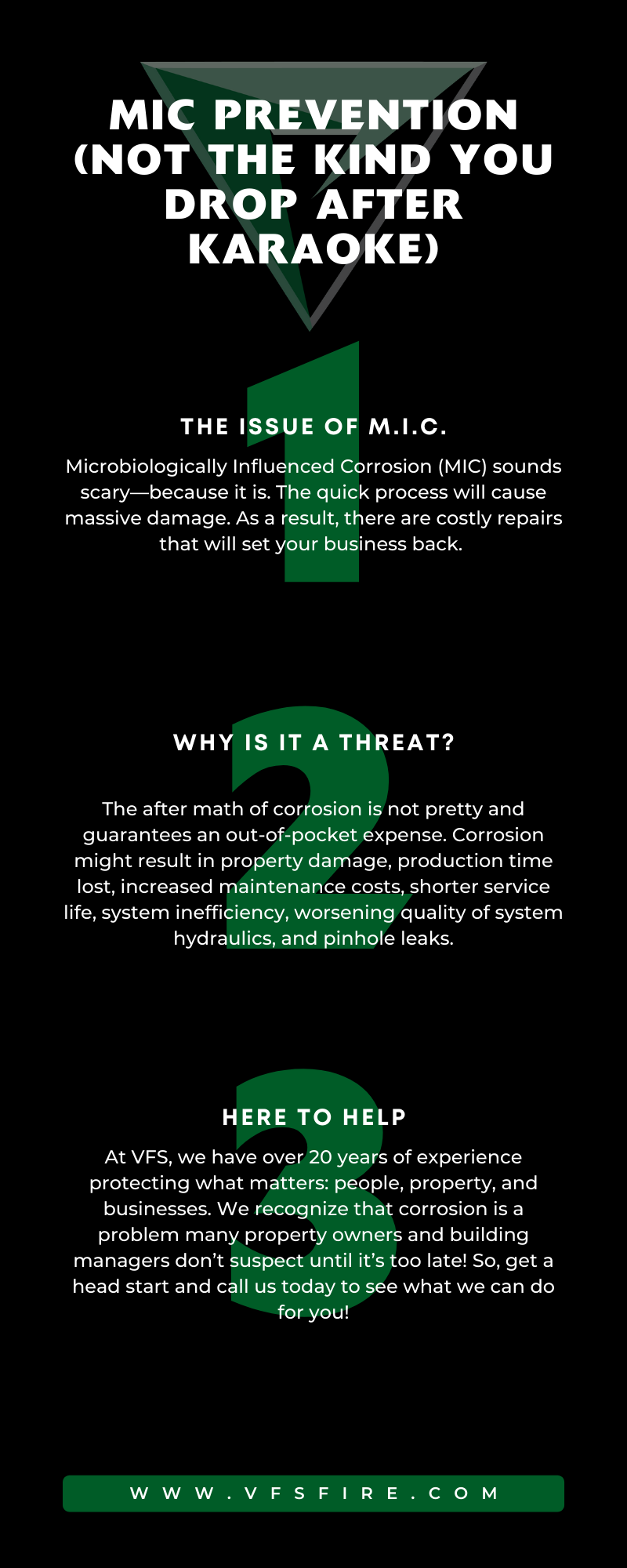
MIC PREVENTION (NOT THE KIND YOU DROP AFTER KARAOKE)

Most people hear the word MIC and are brought back to either a cringy middle school talent show or a late karaoke night. 

After reading this article, your second thoughts are going to be, “Oh, Microbiologically Influenced Corrosion.” 

M.I.C.

Microbiologically Influenced Corrosion (MIC) sounds scary—because it is. The tiny bacteria follow the process of attachment, growth, and dispersal. There are many reasons why preventing MIC is essential for fire and safety security services. 

The quick process of MIC will cause massive damage to specific points in the surface, instead of universally and evenly throughout the surface. As a result, there are costly repairs that will set your business back. 

The attachment phase needs to be targeted first in prevention. During the attachment phase, free-floating microbial bacteria anchor to a surface within minutes of the encounter and start to produce a polymer film. 

Again, within minutes. 

The rest of the MIC process is just as crucial to prevent, but harder to catch. Some of the hazards that are threatening your spaces during the MIC process are: 

  • Self-organized highly-structured biofilm starts to rapidly reproduce and grow
  • Because of the evolution portions, the cells are released to colonize new surfaces
  • The tubercle starts with the creation of biofilm in the attachment phase
  • There is a deprivation of oxygen that causes the bacteria to thrive
  •  Highly acidic environments result in a concentrated and accelerated rate of corrosion
  • This all can lead to pinhole leaks

Sounds fun, right? 

The short time frame (of once again, minutes) doesn’t leave any room for mistakes in MIC prevention.

Fear not, because VFS is here to assist in showing that there are daily habits that you can take to avoid Microbiologically Influenced Corrosion. 

GENERAL CORROSION

There are a lot of scientific terms thrown into the paragraphs above, so you may be wondering: what’s the difference between MIC and general corrosion? 

Well to sum it up, they’re both bad news. 

General corrosion is less significant than MIC because it fails to alter a pipe’s interior surface, causes less damage and repair. While MIC targets concentrated surface areas at a greater force, general corrosion is an even layer, with a slower rate of disintegration.

Both types of corrosion can cause a lot of damage, but focusing on Microbiologically Influenced Corrosion prevention will help your business for the long haul.

WHY IS IT A THREAT?

Well, MIC is primarily an issue of corrosion in both dry and pre-action sprinkler systems.

Corrosion of any type (especially MIC), is a growing concern for anyone with commercial fire protection in place. The aftermath of corrosion is not pretty and a guaranteed out-of-pocket expense. Corrosion might result in:

  • Property damage
  • Production time lost
  • Increased maintenance costs
  • Shorter service life
  • System inefficiency: pipe obstruction, plugging
  • The worsening quality of system hydraulics
  • Pinhole leaks

Both dry and pre-action fire suppression systems primarily use compressed air. This, however, is what leads to corrosion. Compressed air is made of both oxygen and moisture. Trapped oxygen within the sprinkler system mixes with water, which reacts negatively with the material of the internal pipes—the perfect environment for MIC bacteria to thrive!

OKAY WE KNOW IT’S A PROBLEM… NOW WHAT? 

There are various solutions to the scary “C-word” … aka corrosion. Some of the solutions are more intensive and expensive than others. 

CHEMICAL INJECTIONS

Chemical Injections can be included in regular system maintenance, but there are some potential side effects:

  • It’s very costly
  • Chemicals can become harmful when exposed
  • MIC can become immune to the chemicals overtime

PIPE COATINGS

Pipe coatings are specifically designed to only work as an option for new construction. 

ROUTINE MAINTENANCE

Checking in and doing sprinkler inspections and water analysis is another prevention method that should be adapted. There is Annual Single Bottle MIC testing that has MIC and mineral analysis. Another option is the 5 year, 4 bottle MIC testing and water analysis.

AIR RELIEF VALVES

Air relief valves are doable for most sprinkler systems. Because air travels upward these valves are installed at the highest points of the sprinkler system where they automatically release small amounts of air from the system.

Auto-Air relief valves are the most common solution to prevent MIC. There are multiple reasons they’re the crowd favorite: 

  • Safe
  • Cost-Effective
  • Reliable
  • Venting 

Auto-Air Relief valves are reliable because air travels at the top of pipelines and rises in water, which helps maintain proper water pressure and consistent flow. 

Automatic venting is a process that happens while the sprinkler system is being filled, where the air travels up and gets trapped. VFS has all of the knowledge and expertise to prolong the life cycle of your sprinkler system. 

WE’RE HERE TO HELP!

This all sounds scary, and not as fun as dropping the mic after karaoke. 

But remember, that we’re here to help!

At VFS Fire & Security Services, we have over 20 years of experience protecting what matters: people, property, and businesses. We recognize that fire sprinkler corrosion is still a problem many property owners and building managers don’t suspect until it’s too late!

So, get your head start! At VFS, we’re here to help you develop and implement an effective strategy for all of your industrial fire protection needs. Keep your systems in tip-top shape and call us today to see what we can do for you!