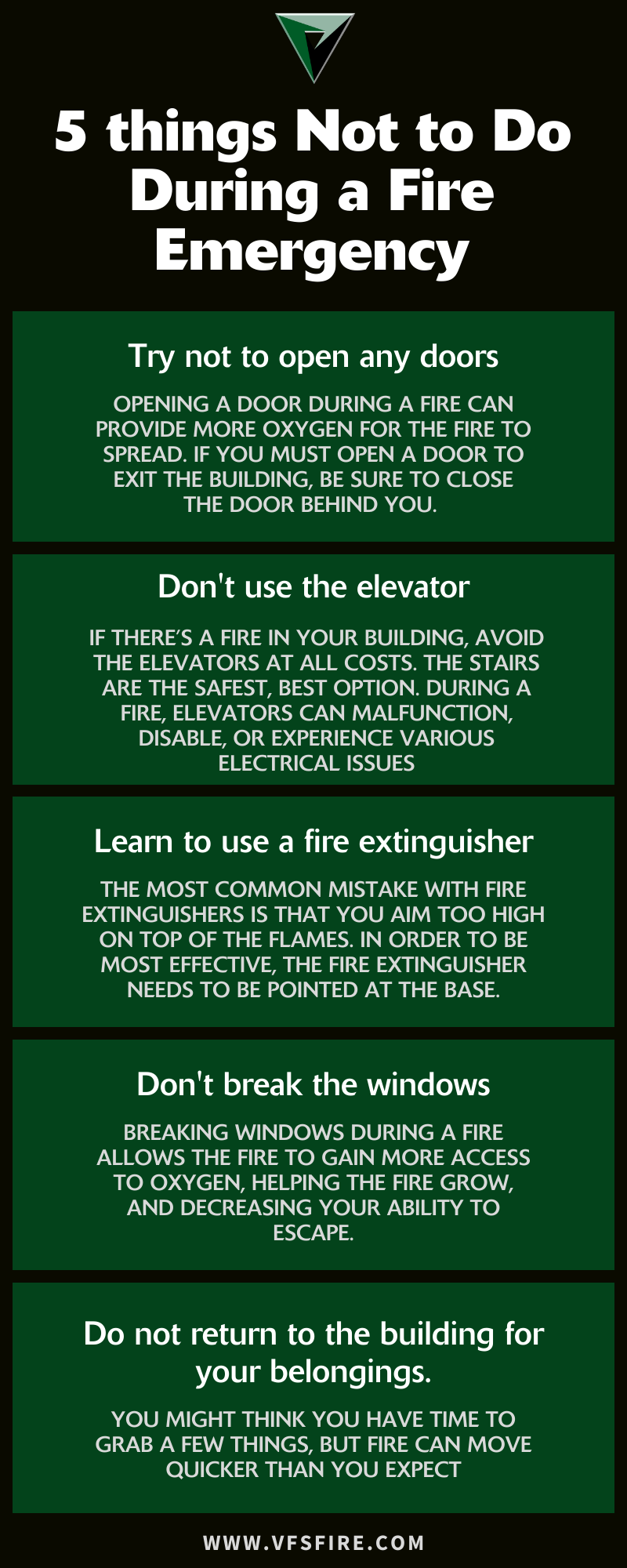
5 things not to do

Stop, drop, and roll, that’s all we need to know about fires right? Not exactly… While that advice is extremely important when you catch on fire, during a fire you need to know exactly what to do, and what not to do. Here are a few tips!

ONE OF THE BIGGEST MISTAKES PEOPLE MAKE IN STRUCTURAL FIRES IS OPENING VARIOUS DOORS WITHOUT CHECKING FOR AN ALTERNATE ESCAPE ROUTE.

While yes, fleeing the scene is an important instinct during a fire, sometimes opening a door can cause more damage than good.  Fires require oxygen to spread. When you open a door (especially one that is warm) the fire receives that oxygen, therefore exposing you to dangerous heat levels and toxic carbon monoxide gas. 

Before you open a door to exit, check for alternate routes where flames have not spread. If you are on the first level of the building, a window can also act as a great exit plan. 

WHAT IF THE FIRE STARTED OR SPREAD IN THE ROOM YOU’RE IN?

If the fire is in the room you’re in, and you need to open a door to exit the danger, please do! However, be sure you close the door behind you to ensure you give a barrier to the fire. Opening the door will invite the fire to spread and potentially follow you out. In an effort to contain the fire, close the door behind you! 

WHILE THE ELEVATOR MAY SEEM LIKE THE QUICKEST WAY OUT, IF THERE’S A FIRE IT COULD PUT YOU IN REAL DANGER! 

If there’s a fire in your building, avoid the elevators at all costs. The stairs are the safest, best option during a fire. During a fire, elevators can malfunction, disable, or experience various electrical issues. When you are in a high-rise or larger building locate the emergency exits and stairwells to ensure you remain safe. 

FIRE EXTINGUISHERS ARE GREAT, BUT YOU NEED TO KNOW HOW TO USE THEM!

Fire extinguishers can save you during a fire. With fire extinguishers, it is important to understand how to use them. The most common mistake with fire extinguishers is that you aim too high on top of the flames. In order to be most effective, the fire extinguisher needs to be pointed at the base. 

When using a fire extinguisher, pull the pin, aim at the base of the flames, squeeze the trigger, and sweep from side to side. As a business owner, it’s important to check fire extinguishers for expiration. Fire extinguishers should be replaced every few years. 

DON’T BREAK THE WINDOWS

Fire-related deaths are typically caused by smoke inhalation rather than the heat of the fire itself. With that being said, breaking windows during a fire allows the fire to gain more access to oxygen, helping the fire grow, and decreasing your ability to escape. When you keep the windows closed you are starving the fire. 

DO NOT RETURN TO THE BUILDING FOR YOUR BELONGINGS. 

As you’re told when you’re in elementary school, leave all your belongings and allow the first responders to fight the fire. You might think you have time to grab a few things, but fire can move quicker than you expect. 

It’s important to understand what you need to do, and not do in case of a fire. We understand it can be challenging to not panic when a fire occurs. The best thing you can do is leave it in a safe way, and allow the first responders to take care of it.
5 movie myths

THE ONLY THING THAT SHOULD BURN IS A DISCO INFERNO

We’ve all seen the scene in The Incredibles when a small amount of smoke from a self-destructing note causes the entire sprinkler system to go off and douse the family. Movies are designed to bring impossibility to reality for viewers. With alien invasions, transforming cars, and flying humans that’s just fine. But one movie effect that is misconceived too frequently is fire safety, and it can be dangerous. 

SPRINKLER SYSTEMS DON’T DRENCH YOU.

One of the most blatant false portrayals of fire protection systems is the use of fire sprinklers. Countless movies have shown us characters getting doused with water after a tiny amount of smoke is near a single sprinkler. 

Sorry to disappoint, but the scene in Die Hard when John McLean sets off all the sprinklers with a lighter is not feasible outside of the big screen. Hollywood dramatics make our perception of fire protection systems skewed.

In reality, each sprinkler head is triggered individually. As the heat spreads throughout a building, more sprinkler heads are activated. While deluge systems do exist, they are not as common and are typically used in very specific applications such as power plants, aircraft hangers, and chemical plants. 

A LITTLE SMOKE DOESN’T TRIGGER YOUR SPRINKLER SYSTEM

Smoke actually does not trigger a sprinkler system to turn on. Despite what The Incredibles depicts, sprinkler systems detect heat in a building and activate based on the heat temperature within the room. In Changing Lanes we see a similar movie myth, Ben Affleck lights a piece of paper on fire and holds it under a sprinkler head, triggering all the sprinkler heads in the office building. As this might add to the theatrics of a Hollywood flick it is not the mechanical truth of a fire sprinkler system.

PULLING THE FIRE ALARM DOES NOT DISCHARGE WATER.

Remember the scene in Mean Girls when the principal hits the fire alarm pull station with a baseball bat and all the sprinkler heads go off? Yeah… that’s not true either. Activating a pull station doesn’t trigger the sprinklers to dispel water, it sends a signal to the main fire alarm panel which activates the alarm and notifies occupants to get out of the building. 

If every time a fire alarm pull station was activated, even accidentally (which happens quite frequently especially in educational environments) and the sprinklers went off, it would cause an immense amount of property damage. Here’s how it REALLY works: when pulling a fire alarm pull station, the alarm sends a signal to the fire alarm panel and activates the alarm to notify occupants to leave. 

YOU CAN USE THE WRONG TYPE OF FIRE EXTINGUISHER. 

Firefighters use dry chemical extinguishers or hose lines to extinguish fires, like the car fire in Terminator 3. The firefighters in Terminator 3 use carbon dioxide fire extinguishers to try to put out the car fire, which, in reality, could have made it worse. In real fire situations, the wrong type of fire extinguisher could spread the fire or not put out the flames. Here’s a quick recap of the different types of fire extinguishers and their uses: 

  • Class A: freely burning, combustible solid materials such as wood or paper
  • Class B: flammable liquid or gas
  • Class C: energized electrical fire (energized electrical source serves as the ignitor of a class A or B fire – if electrical source is removed, it is no longer a class C fire)
  • Class D: metallic fire (titanium, zirconium, magnesium, sodium)
  • Class K: cooking fires – animal or vegetable oils or fats

USING THE ELEVATOR AFTER THE FIRE ALARM OR SPRINKLER GOES OFF WON’T WORK.

A fire breaks out on the 13th floor, the main character jumps into the elevator to get away. If this was actually possible, it would be extremely dangerous. When fire protection systems activate, the elevators will be removed from normal service and recalled to a specific landing. This action prevents the possibility of occupants being delivered to a smoke or flame-filled area. 

Understanding what fire protection services can do for you is an important part of your building safety. While most of the movie scenes are extremely entertaining, they don’t give you an accurate representation of what you should do when a fire occurs. As you start considering your fire prevention tactics, begin with implementing the proper fire safety measures in your building.

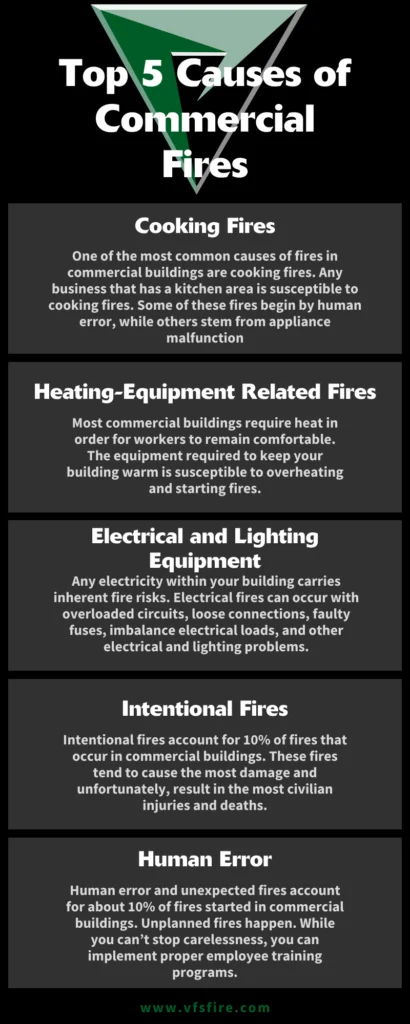
TOP 5 CAUSES OF COMMERCIAL FIRES

We didn’t start the fire????

While Billy Joel’s We Didn’t Start the Fire is an extremely catchy tune, it’s not something you want to hear as a building manager. It’s important to have all the fire protection systems in place to ensure your building’s safety. Fire prevention should be your main priority.

Having all the important precautions in place is important, but you also need to understand why fires start in commercial buildings. Here are the top 5 causes of commercial fires, so you can be prepared when you need it most. 

Cooking Fires

One of the most common causes of fires in commercial buildings are cooking fires. Any business that has a kitchen area is susceptible to cooking fires. Some of these fires begin by human error, while others stem from appliance malfunction. Your kitchen should be considered a high-risk zone and should be adequately protected with sprinkler systems, alarms, and fire extinguishers.

Here are a few of the leading commercial buildings affected by cooking fires:

  • 64% of fires in healthcare facilities are related to cooking.
  • 61% of fires in restaurants are related to cooking.
  • 38% of fires in educational institutions are related to cooking.
  • 29% of fires in office properties are related to cooking.
  • 13% of fires in stores and mercantile properties are related to cooking.

Heating equipment-related fires

During colder months, most commercial buildings require additional heat in order for workers to remain comfortable. The equipment required to keep your building warm is susceptible to overheating and starting fires. This equipment might include central heating units, fireplaces, water heaters, and other heating appliances. Heating equipment accounts for 14% of fires in industrial/manufacturing properties and 11% of fires in office buildings.

Electrical and lighting equipment

Any electricity within your building carries inherent fire risks. Electrical fires can occur with overloaded circuits, loose connections, faulty fuses, imbalanced electrical loads, and other electrical and lighting problems.

Most electrical fires stem from older buildings’ electrical wiring. However, it is important to stay proactive and have your new building inspected. You should also perform preventative maintenance annually. 

Intentional Fires

Intentional fires account for 10% of fires that occur in commercial buildings. These fires tend to cause the most damage and unfortunately, result in the most civilian injuries and deaths.

It is important to implement active fire safety measures and include fire safety in areas that may seem uncommon. These fires typically occur in bathrooms, trash bins, garages, or open areas like a lawn or field.

Human Error

Human error and unexpected fires account for about 10% of fires started in commercial buildings. Unplanned fires happen. They may stem from a variety of situations. For example, employees may leave a space heater on or plug too many things into an extension cord. 

While you can’t stop carelessness, you can implement proper employee training programs. These programs help educate your employees on how to prevent fires and put them out when they do occur. 

At VFS, we are dedicated to ensuring that your building and your employees remain safe from harm. We partner with our clients to develop the best fire protection solutions and safety training based on your business’s specific needs. Fortify your building, protect your employees and gain the peace of mind you deserve knowing that VFS is protecting your business.

be alarmed be very alarmed

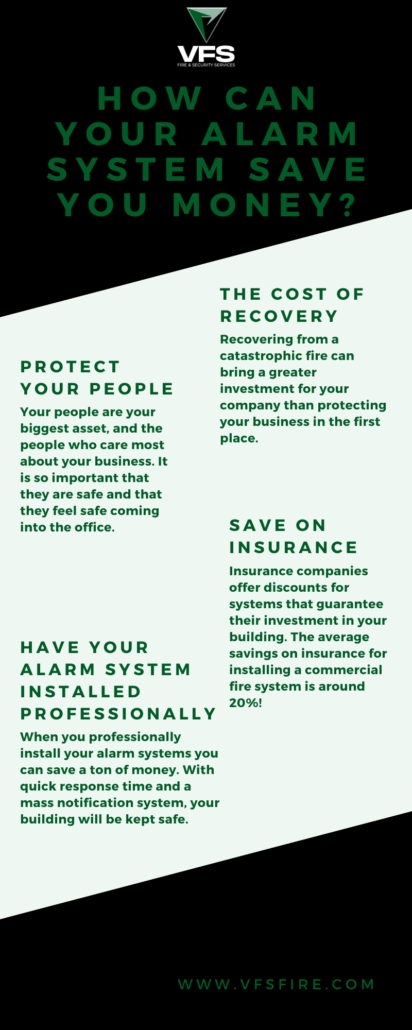
Be alarmed, be very alarmed. Not about ghosts, witches, and warlocks. About your building’s alarm system! It’s time to invest in Fire Alarm systems that work effectively and keep your business safe from harm. Not only will it save your business, but it will also save you money. Here’s how.

PROTECT YOUR PEOPLE

One of the biggest reasons to invest in a commercial fire alarm system is to protect your team. Your people are your biggest asset and are the people who care most about your business. It is so important that they are protected with the best and most reliable fire alarm systems on the market. Just as important as the system itself, is the company you entrust to inspect and maintain them! Entrust VFS Fire & Security Services to support the integrity and reliability of your fire alarm systems and the safety of your people!

THE COST OF RECOVERY

Recovering from a catastrophic fire can bring about a greater investment for your company than protecting your business in the first place. Even if one catastrophic fire can be prevented, the investment in a professionally installed fire alarm system is worth it. Not only do they help you prevent fires while you’re in the office, but they also prevent them when you are away. With proper design, early detection, and advanced technology you can avoid potential damage and loss of assets from an unforeseen fire. 

HAVE YOUR ALARM SYSTEM INSTALLED PROFESSIONALLY

A fire event can have devastating consequences for businesses and their employees. A professionally installed fire alarm system can help to prevent or lessen the severity of such events. Through proactive measures such as staying up-to-date on required inspections, professional maintenance,  and mass notification systems VFS can help protect your employees, your customers, and your property. 

SAVE ON INSURANCE

Insurance companies offer discounts for systems that guarantee their investment in your building. When you implement a top-of-the-line commercial fire alarm system, insurance companies feel safe insuring your business. As an insurance agency, if a fire alarm system saves your building during the night, when you’re on vacation, or if any other unforeseen circumstance occurs, they will feel much better about their investment. The average savings on insurance for installing a commercial fire system is around 20%! 

At VFS, safety is our top priority. We offer top-of-the-line fire alarm systems installed and maintained by licensed professionals to keep your business and people safe! Our team offers in-house design, inspection and testing, maintenance and repair, mass notification systems, safety training, monitoring, 24-hour emergency service, and preventative maintenance. Want to know more? Contact us!

security measures to implement today

Do you know what’s going on in your building when you’re not there? 5 Security measures you should implement today.

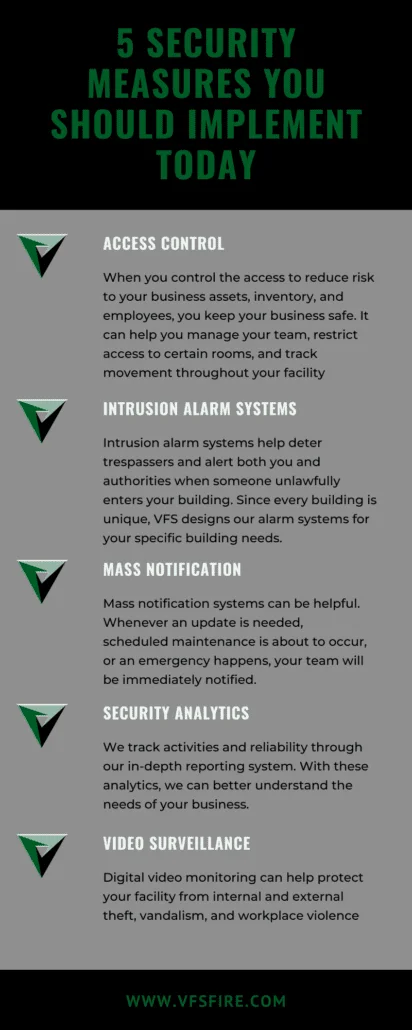
Do you know what’s going on in your building when you’re not there? Probably not. Your old school security system just isn’t going to cut it anymore. It’s important to implement a few security measures to better understand what’s happening in your building at all times. Why do you need to know? There are multiple safety issues that can occur, and with proper security measures in place, you can prevent them! Here are 5 security measures you should implement today.

Access Control

Controlling the access into your building helps to mitigate many risks to your business assets, inventory, and employees. When your access control system is running properly it can help you manage your team, restrict access to certain rooms, and track movement throughout your facility.  At VFS, we readily design top of the line Access Control Systems that integrate into your intrusion alarm systems.

Intrusion Alarm Systems

This is not your simple ‘Beware of Dog’ sign! Intrusion alarm systems help to deter trespassers and alert both you and the authorities when someone unlawfully enters your building. Every building is unique, at VFS our alarm systems are designed for your specific building needs, we integrate Access Control with Video Surveillance to ensure your business’s safety.

Mass Notification

If something happens in your building wouldn’t you like to know? Mass notification systems can help guide and direct your team in an emergency situation. With our advanced technology and proper safety protocols in place, these notification systems can help protect against potential threats that could cause damage or loss of critical assets. Whether you are in a municipal, civil, and defense or manufacturing and industrial environment these systems cut through the noise to clearly communicate critical life-saving information as well as general notification announcements throughout your facility. With industry-leading intelligibility VFS can assist your business in delivering the right message, to the right people, at the right time to help save lives and protect your assets. 

Security Analytics

Along with multiple security system offerings, we track activities and reliability through our in-depth reporting system. With these analytics, we can better understand the needs of your business. Which systems are you using most? What areas of your business need more protection? We’ll find out what you need and implement it. 

Video Surveillance

Digital video monitoring can help protect your facility from theft (both internal and external), vandalism, and workplace violence. If an incident occurs, your team can be on top of it. We connect your system to your IP network so that recorded or live video can be viewed from a computer anywhere there is internet access. These systems can also integrate with your Access Control Systems. 

At VFS, we work to keep your business as safe as possible. Our systems are put in place to do just that. If something isn’t working for your business, we pivot and find something that will better serve your specific building. Contact us to learn more!

“RUN LIKE HELL” IS NOT A FIRE SAFETY PROTOCOL

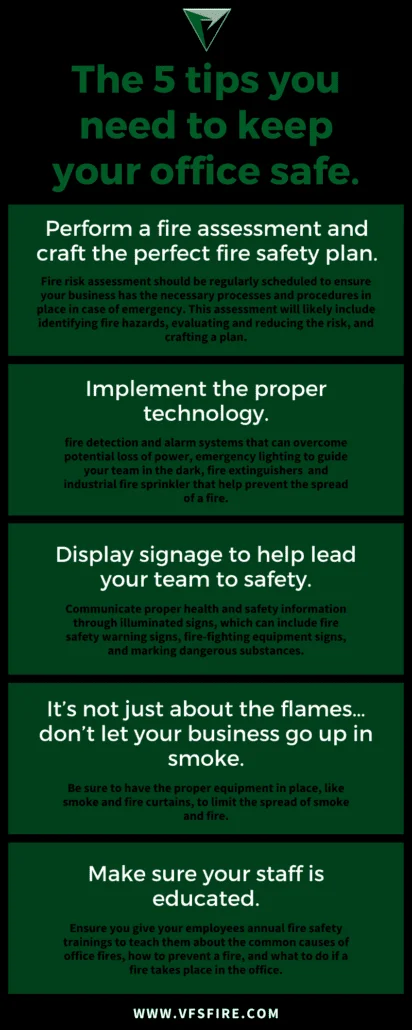
“Run like hell” is not a fire safety protocol. For large corporations, organization is key. For both the safety of your employees and your building, you must prioritize implementing proper fire safety protocols. We’ve put together our top 5 tips for improving fire safety in your building. 

PERFORM A FIRE ASSESSMENT AND CRAFT THE PERFECT FIRE SAFETY PLAN. 

Fire risk assessments should be regularly scheduled to ensure your business has the necessary processes and procedures in place in case of emergency. This assessment will likely include identifying fire hazards, evaluating and reducing the risk, and crafting a plan.

You likely have an old plan, created by a far-off company and tucked away in a drawer, never to be seen again.  This is also not a great fire safety protocol.  For the plan to work, everyone needs to know what the plan is. Be sure to run drills periodically throughout the year. All employees should share problems that arise in those drills with management to avert problems in a real emergency. 

Your fire safety plan should include employee education, fire escape routes, fire drill, and a plan to ensure that all team members have an evacuation plan that fits their needs. The plan should be detailed and robust, to ensure you are prepared for anything that may come your way!

IMPLEMENT THE PROPER TECHNOLOGY. 

We don’t just mean fire extinguishers placed randomly around the office. This means fire detection and alarm systems that can overcome potential loss of power, emergency lighting to guide your team in the dark, industrial fire sprinkler systems to help prevent the spread of a fire, and monitoring to alert the authorities to your emergency. Having the proper technology in place will allow your team to stay safe and your building to come out with limited damage.

DISPLAY SIGNAGE TO HELP LEAD YOUR TEAM TO SAFETY.

Communicate proper health and safety information through illuminated signs, which can include fire safety warning signs, fire-fighting equipment signs, and marking dangerous substances. Be sure the signage is easy to ready and communicates the message clearly.

IT’S NOT JUST ABOUT THE FLAMES… DON’T LET YOUR BUSINESS GO UP IN SMOKE.

Smoke can be just as deadly as flames if your building has a fire. Be sure to have the proper equipment in place, like smoke and fire curtains, to limit the spread of smoke damage as well as the damage caused by fire. 

MAKE SURE YOUR STAFF IS EDUCATED.

Imagining worst-case scenarios is not just for Sci-Fi TV writers… While it can be easy to forget to address the real dangers of fire when you haven’t experienced it, this can be a business’ greatest downfall. Ensure you give your employees annual fire safety training to teach them about the common causes of workplace fires. Address how to prevent a fire, and what to do if a fire takes place in the workspace.

“Run like hell” doesn’t have to be your fire safety protocol. Take these steps to improve your office’s fire safety. Want to know more? Contact us today!

BUILDING COMPLIANCE VS BUILDING COMPLAINTS (NOT JUST A SPELLING ERROR)

BUILDING COMPLIANCE VS BUILDING COMPLAINTS (NOT JUST A SPELLING ERROR)

There’s a good reason for the codes and standards established by the National Fire Protection Association (NFPA).  Compliance isn’t a punishment, it’s a roadmap to safety, protection, and long term sustainability. Building Compliance vs Building Complaints (not just a spelling error)– it doesn’t have to be so overwhelming. 

With over 300 codes written in “legal-ese”, it’s not always as intuitive as it should be to comply with fire safety codes so we’ve created a cheat sheet to steer you in the right direction. 

300 FIRE PROTECTION COMPLIANCE CODES?!?

The likelihood is that your building does not have to comply with all 300 NFPA codes and standards. Searching the NFPA’s database can simplify the process: https://www.nfpa.org/codes-and-standards/all-codes-and-standards/list-of-codes-and-standards

THERE ARE CODES YOU’LL REGULARLY ENCOUNTER SUCH AS 

NFPA 99Health Care Facilities Code

And 

NFPA 72®National Fire Alarm and Signaling Code®

And others that are very specific such as: 

NFPA 418Standard for Heliports

Compliance isn’t the goal, safety is the goal, and – in that vein – we always recommend the following precautions be taken: 

DISPOSE OF EXCESS PACKAGING IN REAL-TIME.  PILES OF BOXES CAN FUEL A FIRE THAT MIGHT OTHERWISE BE EASILY MANAGED. 

Oily rags can spontaneously combust, it seems like the stuff of action moves, and yet, it happens all the time.  Rag disposal is essential to safety.

DON’T PUT A LANTERN IN THE SHED WITH THE COW. 

Check your fire extinguishers.  An expired extinguisher is not only frustrating, it can be deadly. 

A popping sound when you turn on the light is a warning!  Inspect electric lines that are old or unreliable. 

REFINE YOUR DISASTER PREPAREDNESS PLAN FOR FIRE, EARTHQUAKE, FLOOD, LOCUSTS, AND ANY OTHER EVENTUALITY.

Make sure everyone knows what to do, who is in charge, how to get out, and where to go once they get out. 

BRING IN THE EXPERTS AT VFS.  WE’VE SEEN IT ALL. 

Our teams can ensure compliance and ensure that compliance isn’t all you’re doing to prevent fires. We are a full fire and life safety contractor and after-market service provider. Whether your needs are related to fire sprinkler systems, alarms systems, extinguishers, backflows, fire pumps, suppression, special hazards, monitoring, DAS systems, emergency notification (the list goes on and on) we can not only inspect and maintain those systems but we also design, build and install! With our inspections program, we manage, schedule, and track your inspections, deficiencies, and repairs so you don’t have to. 

At VFS we pride ourselves on the caliber of our team members, our commitment to a holistic understanding of your needs, and our sommelier level wine collection (get to know our founder).  We are the team you want to bring on to your project.  Connect with us, take a look inside.

Take theses precautions to keep your building safe
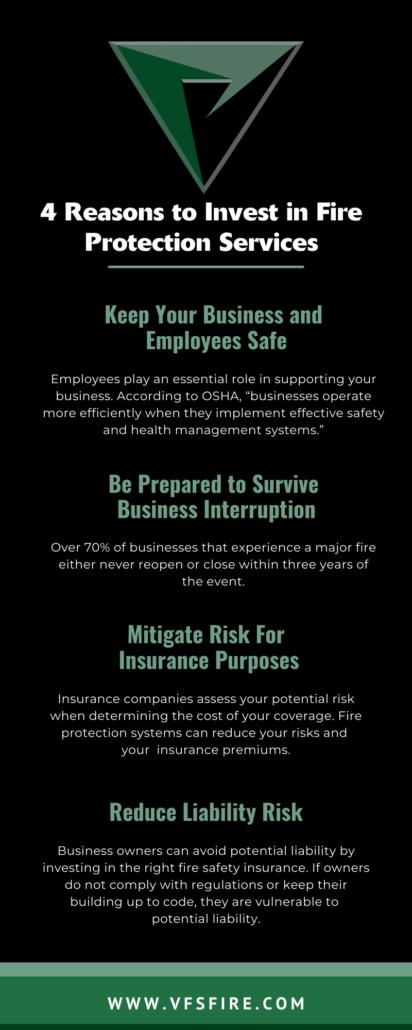
4 REASONS TO INVEST IN FIRE PROTECTION SERVICES TODAY.

Many business owners choose not to invest in fire protection services to cut costs and improve their bottom line. However, these business owners may not realize that the scope of fire protection goes beyond the event of a fire itself. In fact, fire protection services benefit businesses long before and well after an incident occurs.

Read on to learn how investing in fire protection services can protect your business and employees, cut insurance costs, and help your company survive business interruption and make a successful recovery. 

Keep Your Business and Employees Safe 

The most important reason to invest in fire protection service is to keep both your business and your employees safe. 

Protect Your Business

Any fire can devastate your business. Small fires may damage your property enough to halt business operations for a few days. Large fires may result in the complete loss of your building, materials, merchandise, important documents or records and, in the worst cases, harm an employee or customer. 

Each of these outcomes also carries major financial risk. Investing in fire protection services can help to reduce this risk and protect the business you worked so hard to build. 

Protect Your Employees

According to OSHA, “businesses operate more efficiently when they implement effective safety and health management systems.” 

Employees play an essential role in supporting your business. By making them feel safe and protected in their workplace, you are helping them to be more productive as well as treating them with the care they deserve. Your business is their livelihood and protecting it is not just about protecting your assets, it’s about protecting them too. 

Be Prepared to Survive Business Interruption

Over 70% of businesses that experience a major fire either never reopen or close within three years of the event. 

The high percentage of businesses that fail following a fire is largely due to the intensity of business interruption fires cause. If you are well-equipped to handle a major fire, you will be better prepared to survive business interruption. The 30% of businesses that survive fires likely recover because they had plans in place before the event occurred. 

Mitigate Risk For Insurance Purposes

Insurance companies assess your potential risk when determining the cost of your coverage. 

The cost of fire safety is a drop in the bucket compared to the cost of recovering from a fire and subsequent increases in insurance premiums. Therefore, it is important to have all the precautions in place to reduce any potential risk. Additionally, fire safety services can help your business avoid potential workers’ compensation payments.

Reduce Liability Risk

Business owners can avoid potential liability by investing in proper fire safety insurance. If owners do not comply with regulations or keep their building up to code, they are vulnerable to potential liability. The best way to keep yourself and those in your building safe is to invest in high-quality fire protection.

How to Invest in Fire Protection Services

Business owners have a range of fire protection services to choose from to protect their businesses and employees. For example, fire safety services and solutions may include: 

  • Fire sprinkler systems
  • Fire suppression systems
  • Fire alarm and detection systems
  • Portable fire extinguishers
  • And more

At VFS,  we want to help protect your employees, your company, your assets, and your building from any potential fire risk. 

Contact us today to learn more about our services and see how we can help.

Read on to learn the difference between fire protection and fire prevention, here.


NITROGEN GAS MITIGATION TO INHIBIT CORROSION

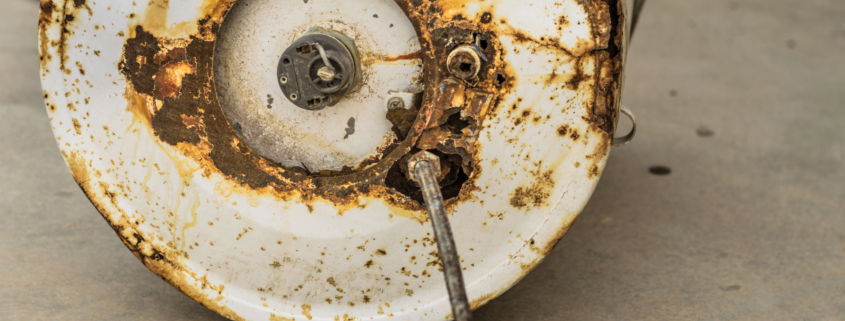
Dry and pre-action systems are the world’s second most common type of fire suppression system. With increasingly widespread use of these systems, the issue of corrosion has become very common.   Internal corrosion of dry and pre-action fire suppression systems is a growing concern for the fire sprinkler industry. Corrosion in these systems causes failures resulting in property damage, production downtime, and increased maintenance costs. Additionally, corrosion impacts system hydraulics and reduces the efficiency of fire sprinkler system designs. Historically, dry and pre-action fire suppression systems have used compressed system air as the primary supervisory source. Compressed air, however, contains both oxygen and moisture promoting a corrosive system environment.

Approval agencies, design engineering firms, and component manufacturers have teamed up to investigate the main cause of corrosion in fire sprinkler systems. Recent testing shows the removal of Oxygen in both wet and dry pipe fire sprinkler systems can extend the life cycle of the systems by as much as 3-6 times.

Based on the test results, venting wet fire sprinkler systems and using Nitrogen in dry and pre-action systems will give you the maximum life cycle for your system components. The recent NFPA 13 code change for 2016 requires the venting of wet pipe fire sprinkler systems. This can be accomplished by manually or automatically venting of oxygen. The approval agency FM is now aware of the benefits of reduced oxygen in both wet and dry fire sprinkler systems to the point of restricting the use of air compressors and requiring wet systems to be vented.

Because of the strong need for corrosion protection sprinkler systems, Potter Electric Signal Company conducted a test comparing the effects of using 98% pure nitrogen gas compared to compressed air systems. The systems were half filled with water and then allowed to sit for 12 months. After 12 months the systems were tested and it was found that:

  1. The use of 98% nitrogen in lieu of compressed air as a supervisory gas reduces corrosion in both galvanized and black steel systems regardless of whether or not trapped water is present. The corrosion reduction potential ranges from 48% to 91% when compared to compressed air.
  2. Using 98% nitrogen gas in lieu of compressed air increases the life expectancy of a dry or pre-action system on an average of 5.3 times.
  3. The use of galvanized steel instead of black steel results in higher metal loss rates when compared in equivalent environments.
  4. The use of 98% nitrogen gas in a relatively dry, black steel environment has the lowest corrosion rate overall.

Based on these results, using nitrogen gas for fire protection systems will help increase the life of the system by causing less corrosion.

For more information on nitrogen gas use for fire protection systems, please contact VFS today!


reg inspections

As building owners and managers, one of your most important responsibilities is to make sure your building is safe for all its occupants. According to NFPA code, quarterly and yearly inspections of your fire and life safety systems are mandatory. In addition, some components of a system like a fire pump, require weekly and monthly inspections. It is best to consult your VFS Account Executive for details. Having your building inspected by trained and certified inspectors will help keep your safety systems in good working order.

Read more